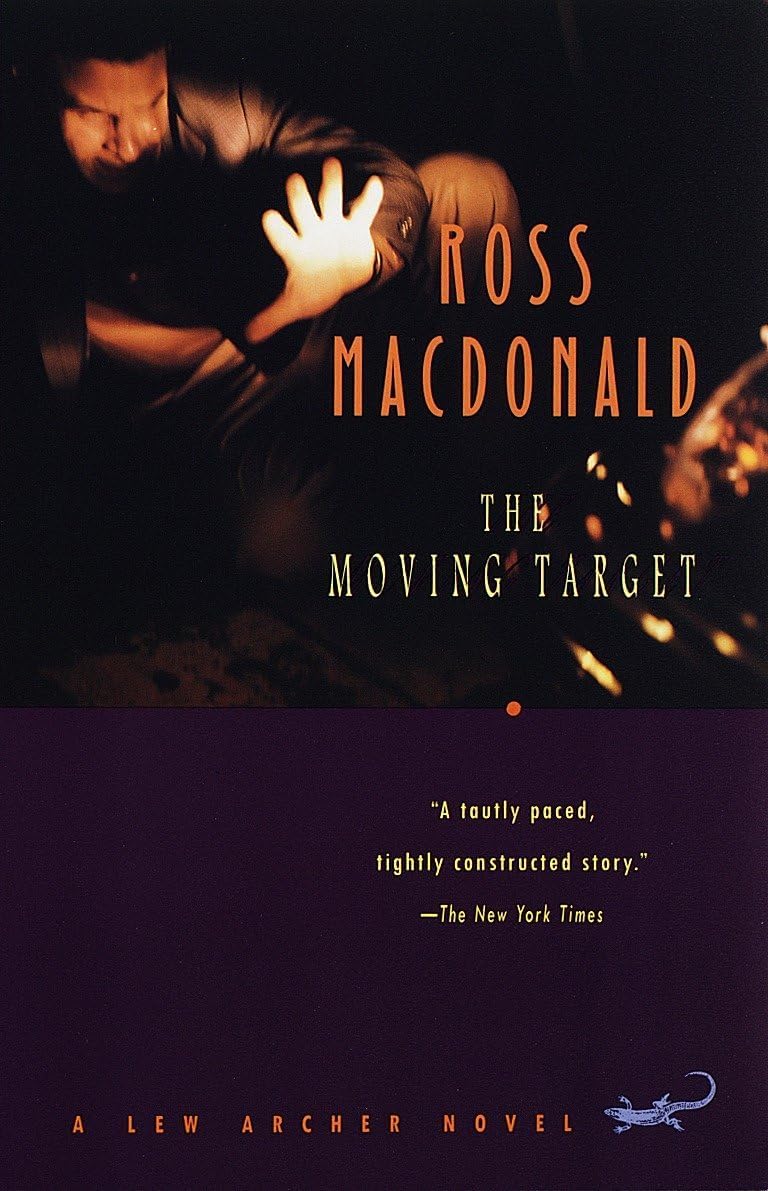
The Moving Target (Lew Archer Series)
Product ID: 10972930
Desertcart purchases this item on your behalf and handles shipping, customs, and support to UAE.
The first book in Ross Macdonald's acclaimed Lew Archer series introduces the detective who redefined the role of the American private eye and gave the crime novel a psychological depth and moral complexity only hinted at before. Like many Southern California millionaires, Ralph Sampson keeps odd company. There's the sun-worshipping holy man whom Sampson once gave his very own mountain; the fading actress with sidelines in astrology and S&M. Now one of Sampson's friends may have arranged his kidnapping. As Lew Archer follows the clues from the canyon sanctuaries of the megarich to jazz joints where you get beaten up between sets, The Moving Target blends sex, greed, and family hatred into an explosively readable crime novel. Review: My Favorite American Crime Noir Novel Thus Far - "The Moving Target" by Ross Macdonald is an American Crime Noir Novel published in 1949. It is the first of the "Lew Archer" series. It is set in California on the Pacific Coast. The story is clever and interesting. The writing is particularly good. There are a LOT of very descriptive passages of scenery. I like that very much. There are some very interesting metaphors. The scenery and metaphors are what make this novel so very good to me, more so than the mystery. The mystery itself is clever. For a reader not enthralled with scenery, this may not prove as enjoyable a novel as it does to me. I have been conducting a survey of American Mystery Noir form the 1920's, 30's, 40's, and 50's. Of the novels that I have thus far read in this category, this is my favorite. American Society has evolved since 1920. Certain terminology about ethicity and gender are no longer acceptable. While I don't believe at all in censorship, and contnue to read novels as written, as a reviewer I want to enable readers to either avoid the "cringe factor" or be alert to its presence. This particular novel seems more erudite and less crass than many novels in this category. The setting for this novel is Sante Teresa, California. This is a fictional city. The reason I mention this is that Sante Teresa, California is also the setting of Sue Grafton's "Kinsey Millhone" novels. Sue Grafton's writing puts me in mind of Ross Mcdonald. Her fiction is somewhat lighter and has some comedic aspect that this novel does not have. This novel is excellent, but it is definitely Noir. In summary, I really like this novel. This is my favorite thus far of American Crime Noir from this period. I read the novel on Kindle and listened to the audiobook simultaneously. The audiobook is also excellent. However with intricate writing of scenery, I also need to reread and re listen. for me this is really worth the effort. Thank You... Review: 1949 but Still a Very Good Read - This will be my 5 th time reading this book. The first time was 40years ago. It has aged well . f you like a good gritty hard nosed detective novel this is a good read.

| Best Sellers Rank | #148,587 in Books ( See Top 100 in Books ) #552 in Hard-Boiled Mystery #1,192 in Private Investigator Mysteries (Books) #6,848 in Suspense Thrillers |
| Customer Reviews | 4.1 out of 5 stars 1,199 Reviews |
F**Y
My Favorite American Crime Noir Novel Thus Far
"The Moving Target" by Ross Macdonald is an American Crime Noir Novel published in 1949. It is the first of the "Lew Archer" series. It is set in California on the Pacific Coast. The story is clever and interesting. The writing is particularly good. There are a LOT of very descriptive passages of scenery. I like that very much. There are some very interesting metaphors. The scenery and metaphors are what make this novel so very good to me, more so than the mystery. The mystery itself is clever. For a reader not enthralled with scenery, this may not prove as enjoyable a novel as it does to me. I have been conducting a survey of American Mystery Noir form the 1920's, 30's, 40's, and 50's. Of the novels that I have thus far read in this category, this is my favorite. American Society has evolved since 1920. Certain terminology about ethicity and gender are no longer acceptable. While I don't believe at all in censorship, and contnue to read novels as written, as a reviewer I want to enable readers to either avoid the "cringe factor" or be alert to its presence. This particular novel seems more erudite and less crass than many novels in this category. The setting for this novel is Sante Teresa, California. This is a fictional city. The reason I mention this is that Sante Teresa, California is also the setting of Sue Grafton's "Kinsey Millhone" novels. Sue Grafton's writing puts me in mind of Ross Mcdonald. Her fiction is somewhat lighter and has some comedic aspect that this novel does not have. This novel is excellent, but it is definitely Noir. In summary, I really like this novel. This is my favorite thus far of American Crime Noir from this period. I read the novel on Kindle and listened to the audiobook simultaneously. The audiobook is also excellent. However with intricate writing of scenery, I also need to reread and re listen. for me this is really worth the effort. Thank You...
K**R
1949 but Still a Very Good Read
This will be my 5 th time reading this book. The first time was 40years ago. It has aged well . f you like a good gritty hard nosed detective novel this is a good read.
S**Y
All the Classic PI Elements
"Her voice was clear and fresh, but the sickness was there in her laugh, a little clatter of bitterness under the trill," private detective Lew Archer says of his new client. She wants him to find her rich husband, who, it seems, gave his private pilot the slip and went off on his own. Not an unusual occurrence, she explains, but the man has been known to do foolish things when he is drunk and unsupervised. He tends to give things away -- things she that will be hers when he dies. The case of the missing Ralph Sampson sets the plot in motion in "The Moving Target", the first book in Ross MacDonald's series featuring Lew Archer. Copyrighted in 1949, the book contains all of the elements of the classic tough guy, PI genre of the period. Characters include Sampson's beautiful daughter who seems to be in love with his handsome, indifferent pilot; the family attorney, an old friend of Archer's, who seems to be in love with the daughter; a shady nightclub owner; his movie actress wife, whose star has almost faded; an attractive has-been pianist; and a strange "spiritual" advisor, who lives on the mountain Sampson gave him. There are guns, fist fights, beatings, uncooperative cops, and mysterious chauffeurs. There are Archer's thoughts on life and things that shout there is more going on than first meets the eye (so to speak). All of this makes for an enjoyable read that is somewhat reminiscent of John D. MacDonald and echoes Raymond Chandler. This is not the best book in the series, but it is the place to start reading the Archer books and a good read -- even if at least one of the bad guys seems pretty evident to the reader before Archer seems to tumble to him.
C**D
Superbly crafted detective novel
It seems that seventy years years ago, when this book first was published, Americans had higher expectations for their entertainment. Watch any film from that era, and while the pacing and storytelling style may not resonate, you might find yourself impressed with the repartee between the characters. Ross McDonand's "The Moving Target" reflects the standards and expectations of that age, with a masterly use of vocabulary, always-correct grammar, and scintillating dialog that one does not typically see in modern offerings. The prose is tight yet evocative. McDonald's descriptions of mid-20th century Southern California are beautifully written, vivid and informative, yet the Los Angeles of 1949 he illustrates should be perfectly recognizable to any present-day Angelino. The Lew Archer character adopts a just-the-facts voice that is reminiscent of Jack Webb's character in the 1950s / 1960s Los Angeles TV series, Dragnet. Yet Archer is more nuanced, an interesting combination of urbane city dweller, astute observer of the human condition, and bare-knucked (when necessary) bulldog, with dose of ex-cop cynicism and a never-wavering sense of moral propriety. The pacing of the story is realistic yet easily should satisfy the modern reader, and, at least to this reader, the story is plenty entertaining. Where the book truly stands out, though, especially in the context of today's mass-published, seemingly rushed crime novels whose editors seemingly were asleep at the wheel or distracted by social media, is in the quality of the writing and editing. In short, this book represents the apogee of the detective novel craft.
J**T
Not his best-though OK for fans
Any Lew Archer book is better than much of what passes for noirish detective fiction. Having said that, this isn’t one of MacDonald’s best. Oh sure, it’s got the dangerous dames, the twisty plot, and some of those classic similes. It’s got dirty money, really bad men, and even a nice tug between good and evil. It’s just not enough. So, if you’re new to Lew Archer, don’t start with this one. If you’ve read almost all of them, maybe round it out with this.
G**S
Good read
Good read
J**N
One of the Best!
I had never read Ross Macdonald until I saw this novel rated as one of the best mysteries of all time - and it is! The characters and the story line stand the test of time and will capture your interest immediately and keep it to the very end. An ending I'm sure you won't figure out ahead of time!
B**R
First Came Spade, Then Came Marlowe, And Now Archer
Archer is hired to find missing millionaire by his wife who wants to find out whether he has runaway with another woman, or if he is legitimately in trouble. Archer tracks him down to Los Angeles where the man was last seen, where he comes across a gangster, a thug, an aging actress, and money. But how does it all tie together? And that's not even counting the odd religious type who lives up in the mountains near Santa Teresa. The cast also includes a lawyer friend of Archer's. a young pilot, a washed up piano singer, the millionaire's young tease of a daughter. I will admit, i came across a few unsavory similes like a car that was "...acned with rust..." a line Raymond Chandler found distasteful, but overall it is a book worth reading. Ross MacDonald is more cerebral here by fleshing out the characters a bit more and exploring them psychologically. Even the killers aren't all the bad. This being my first Lew Archer book, I have to say that I found it very suspenseful and thrilling and I look forward to read more of his adventures.
P**N
The Moving Target by John Macdonald
THE MOVING TARGET by John Macdonald. This, the first ever Lew Archer private detective novel, was written by John Macdonald in 1949. Macdonald was one of the greatest twentieth century crime writers but changed his name in later novels and reprints to John ‘Ross’ Macdonald or simply Ross Macdonald to avoid confusion with the other rising crime author John D. MacDonald. In the early Lew Archer novels the shades of noir are apparent. The slowly populating California that we meet here has a wild and hollow atmosphere still in a transitional void after the Second World War. At one point Archer tracks a suspect to a coastal bar where the large dance floor is half deserted with an empty orchestra stand and the music emanating from a jukebox. Customers can remember better days when the place was jumping. Adjusting to peacetime has empty moments like this throughout, as if caught between certainties. The Moving Target begins with Archer taking a cab to an exclusive area of wealthy homes to meet his client, a bored and beautiful rich man’s wife, paralysed from a riding fall, but afraid that her older husband is giving away his money when drunk. He has temporarily disappeared and she wants Archer to find him. Throw in a twenty-year-old stepdaughter, a handsome young pilot who the daughter fawns on unrequitedly and a forty-year-old lawyer who thinks he has a chance with the daughter, and as Lew observes in this first-person narrative, “It was a triangle, but not an equilateral one”. Ahead of its time is an understanding of the growing narcotics problem that would permeate the west coast state in later years. Like the references to astrology in this tale it’s deftly handled as part of someone’s character, embodied again in a woman, this time a nightclub singer, but easily missed if you hadn’t encountered an addict in real life – and what average provincial reader in the late 1940s would? Although the main crime in the story will involve kidnapping and murder, Archer discovers another local lucrative criminal activity – the smuggling of illegal immigrants in from Mexico. Seventy years later this was still a big issue in Donald Trump’s 2016 presidential campaign. Some of this highly intelligent, articulate and sad story I remember from seeing the film in the 1960s (called Harper in the US). The movie, in colour and with a Sixties’ beat, followed the postwar novel fairly closely despite the seventeen years that separated book and film, transforming its lonely noir undertones into a more hip and swinging California.
S**Y
A classic
Great story, well written, anyone who likes hardboiled private detective stories will enjoy this. One of the classics, he is as good as Chandler.
M**A
D'un autre temps
Différents sites conseillent de lire cet auteur si vous aimez Michael Connelly. Il y a en effet un petit fond commun dans la façon d'écrire (c'est subtil, et cela tient notamment au thème de l'anti-héros qui mène l'enquête). La différence ? Celui-ci a été écrit 70 ans avant Connelly ! Cela donne un livre avec des personnages féminins totalement idiots et stéréotypés, des remarques sexistes à la pelle, du "male gaze" (dés qu'un personnage féminin entre en scène, il commente ses seins !!! Systématiquement....). Et le (anti)héros-détective semble plus paumé qu'autre chose, n'ayant aucun éclair de génie qui le conduit vers la solution, qui si'mpose d'elle même au fil des évènements. Bref, je mets 3 étoiles car il les méritait sans doute après la deuxième guerre mondiale, aujourd'hui c'est dépassé.
C**0
I liked it.
Ross Macdonald's Lew Archer series of books is highly rated by critics and crime fiction aficianados alike. It's been a series I've wanted to try for a while and one I've ignored for about seven or eight years since hoovering up some of the books. I think I had a stalled effort at reading this one a year ago, before setting it aside. Wrong book, wrong time, but second time around it stuck and I managed to re-start, get past where I stopped before and then enjoy the thing. Best book ever? No, but I did like it enough to know that the investment made in the other books won't have been wasted. A missing billionaire and a ransom note and a case for Lew Archer....... a dysfunctional family, love triangles, tension, jealousy, a cult, an investigation, more death along the way and answers. I read this about a month ago and I'm kind of struggling to remember all the twists and plot points and leads, mis-steps, characters and incidents in the book, which doesn't mean to say I didn't like it. It's more a reflection on my memory and perhaps an indicator that I ought to jot things down as I go along or shortly after if I want to offer some coherent thoughts on my reading (mostly for my own benefit as I look back). I like older books where there's no reliance on technology to locate people, through either mobile phone triangulations or credit card transactions, where computers take the legwork out of investigations. This one is before my time, but it's the close to the world I grew up in. I think it's a book which has aged well. Other plus points.... California setting; a decent, likable main character; a cohesive plot which made sense and didn't require any suspension of disbelief, one which isn't overly reliant on incident or action to maintain my interest. It made a bit of a change from my usual reading and along with some other older books I've recently read - Ed McBain (50s), Sjowall and Wahloo (60s), David Craig aka Bill James (70s) - it's breathed a bit of old new life into my favourite passion. 4 from 5 Ross Macdonald wrote nearly twenty Lew Archer books as well as a few other novels. The Drowning Pool is the second in the series and the next one I'll be reading. Read - June, 2020 Published - 1949 Page count - 196 Source - purchased copy Format - paperback
M**T
Great book
Working my way through a new authors books
Trustpilot
3 weeks ago
2 days ago