
Buy anything from 5,000+ international stores. One checkout price. No surprise fees. Join 2M+ shoppers on Desertcart.
Desertcart purchases this item on your behalf and handles shipping, customs, and support to UAE.
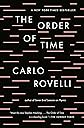
One of TIME’s Ten Best Nonfiction Books of the Decade "Meet the new Stephen Hawking . . . The Order of Time is a dazzling book." -- The Sunday Times From the bestselling author of Seven Brief Lessons on Physics , Reality Is Not What It Seems , Helgoland , and Anaximander comes a concise, elegant exploration of time. Why do we remember the past and not the future? What does it mean for time to "flow"? Do we exist in time or does time exist in us? In lyric, accessible prose, Carlo Rovelli invites us to consider questions about the nature of time that continue to puzzle physicists and philosophers alike. For most readers this is unfamiliar terrain. We all experience time, but the more scientists learn about it, the more mysterious it remains. We think of it as uniform and universal, moving steadily from past to future, measured by clocks. Rovelli tears down these assumptions one by one, revealing a strange universe where at the most fundamental level time disappears. He explains how the theory of quantum gravity attempts to understand and give meaning to the resulting extreme landscape of this timeless world. Weaving together ideas from philosophy, science and literature, he suggests that our perception of the flow of time depends on our perspective, better understood starting from the structure of our brain and emotions than from the physical universe. Already a bestseller in Italy, and written with the poetic vitality that made Seven Brief Lessons on Physics so appealing, The Order of Time offers a profoundly intelligent, culturally rich, novel appreciation of the mysteries of time. Review: Hawking & Sagan in one: An abstract journey sure to inform and entertain - Carlo Rovelli has the brilliance of Stephen Hawking and Albert Einstein and the communicative skills of Carl Sagan. Otherwise he is an Italian theoretical physicist that specializes in quantum gravity and is a proponent, if not quite an advocate, of loop theory. Beyond that he is a philosopher with a heart for ancient poetry and love. And he brings all of it to bear in this delightful book about time, which, in the end, is life, and everything, including the context in which it unfolds. It would be in error to suggest that time doesn’t exist, but it would be equally in error to suggest that time is as simple as the continuum we record with our clocks. What I like most about the book is the fact that Rovelli recognizes that philosophy and science, if not two sides of the same coin, are cousins. He refers to Proust, which few scientists do, and suggests that while reason is among the best tools available for interpreting our “collective delirium,” it is “only an instrument, a pincer.” The science and the prose are very accessible. You will, however, have to be willing to think abstractly, a skill that in our wired, binary world seems to be greatly dissipating. And he is the first scientist I have read in a while who takes time to explain why the problem is sometimes not the science itself, but the limitations of language. Language is a human construction and has not kept up with our scientific revelation. Which is why theoretical physicists sometimes seem to be speaking another language. If only there was another language that was constructed in the world as we know it today, our communication would be so much easier and our knowledge would expand more rapidly. It would be impossible to summarize the knowledge contained in this book. You really have to read it. Here is a start, however: “The world is not a collection of things, it is a collection of events.” If you can comprehend that the rest is largely additional perspective. And if the idea that universal time doesn’t exist in any absolute sense seems a stretch, consider Rovelli’s simple explanation (I’m paraphrasing): People never used to worry about clocks. They worried about the cycle of sunshine and darkness. But that cycle is different in every single village, town, and city on the planet. The cycle varies both east to west and north to south. And back when we used to spend our lives in our little village we didn’t care. But then the scientists and engineers invented trains to take us from one village to the next. And people needed to know when the train left their village. But how can you develop a timetable when every village has its own time? You can’t. But, at the same time, it’s not quite practical to say that the whole world has just one time. Farmers don’t care what the sun is doing in London. They care what it’s doing on their farm. (China actually has no time zones by edict. The entire country is on Beijing time and there are significant practical limitations.) The solution was the time zone, and it’s a compromise. Time zones are a construct and practical in the local sense, but highly inaccurate when talking about the universe. In the language of theoretical physics, they don’t exist. Eastern philosophers believe that reality is not knowable. It is real, but is made up of an infinite number of variables. We can only comprehend or think about a handful at a time. A tree is real. I can touch it and smell it. But it is not entirely knowable because there are too many variables (e.g. altitude, climate, soil, etc.) that define each tree for me to know them all. Time is the same way. Time is real but it is not knowable. Throw in the limitations of language and it begins to look like an illusion. To his great credit, Rovelli admits that there is much we don’t know. Think of a Seurat painting that has been blacked out. We have exposed a few, perhaps 10% (my number), of the original dots of pigment. It’s a lot, but we’re still guessing as to what the underlying picture is. And that’s pretty exciting. The key to our understanding to date, however, is the second law of thermodynamics which states that entropy can never decrease. It’s critical to our understanding of time, as Rovelli explains. Personally I’m not convinced it’s inviolate. Perhaps we just haven’t uncovered enough dots of pigment yet. If entropy could work both ways it would explain a lot, but attraction does not equal fact. (Entropy obviously has a big role in causality, of course. Bidirectional entropy would be a huge boost for inductive reason.) It’s a short book and even if you get through a small amount of it you will learn a lot. Beyond writing in an accessible way, Rovelli comes off as very personable. The perfect person to sit down and share a cup of coffee with. If only he had the time. (Sorry) A marvelous book that I highly recommend. Review: Somewhat Disappointing. - Rovelli is a physicist, but in this book he comes across as more of a philosopher, taking on the meanings of "here", "now", and even death and life. I was hoping for more of the physics of time and how it factors into the equations that describe the world we live in. Could time be fundamental and determine the "speed" of causality and light? Not even a hint of this from Rovelli. Maybe time is simply too difficult to understand and, therefore, not included in our physics. However the physics of time was addressed only in the first couple of chapters, in which he noted that time is a factor in only one equation of classical physics, and none in quantum physics. How can this be -- that time is not a factor in the physics of our world and universe when we live with it every day? In fact, Rovelli essentially dismisses time altogether. He says," Perhaps the [human] emotion of time is precisely what time IS for us. I don't think there is much more than this to be understood." Wow! In this respect, I was a bit disappointed in the book, although it is well written and easy to read. Lots of deep-thought philosophy, and references to ancient and contemporary philosophers. There was only one simple equation (although there were equations in the footnotes), not even Einstein's famous equation, although many mentions of Einstein himself. I would recommend this book to anyone who wants a philosophical approach to the meaning of time, but very little of the theoretical physics of time, even though the author is a theoretical physicist, working on the elusive topic of quantum gravity.


| Best Sellers Rank | #8,434 in Books ( See Top 100 in Books ) #1 in Physics of Time (Books) #1 in Relativity Physics (Books) #2 in Cosmology (Books) |
| Customer Reviews | 4.4 out of 5 stars 5,850 Reviews |
G**R
Hawking & Sagan in one: An abstract journey sure to inform and entertain
Carlo Rovelli has the brilliance of Stephen Hawking and Albert Einstein and the communicative skills of Carl Sagan. Otherwise he is an Italian theoretical physicist that specializes in quantum gravity and is a proponent, if not quite an advocate, of loop theory. Beyond that he is a philosopher with a heart for ancient poetry and love. And he brings all of it to bear in this delightful book about time, which, in the end, is life, and everything, including the context in which it unfolds. It would be in error to suggest that time doesn’t exist, but it would be equally in error to suggest that time is as simple as the continuum we record with our clocks. What I like most about the book is the fact that Rovelli recognizes that philosophy and science, if not two sides of the same coin, are cousins. He refers to Proust, which few scientists do, and suggests that while reason is among the best tools available for interpreting our “collective delirium,” it is “only an instrument, a pincer.” The science and the prose are very accessible. You will, however, have to be willing to think abstractly, a skill that in our wired, binary world seems to be greatly dissipating. And he is the first scientist I have read in a while who takes time to explain why the problem is sometimes not the science itself, but the limitations of language. Language is a human construction and has not kept up with our scientific revelation. Which is why theoretical physicists sometimes seem to be speaking another language. If only there was another language that was constructed in the world as we know it today, our communication would be so much easier and our knowledge would expand more rapidly. It would be impossible to summarize the knowledge contained in this book. You really have to read it. Here is a start, however: “The world is not a collection of things, it is a collection of events.” If you can comprehend that the rest is largely additional perspective. And if the idea that universal time doesn’t exist in any absolute sense seems a stretch, consider Rovelli’s simple explanation (I’m paraphrasing): People never used to worry about clocks. They worried about the cycle of sunshine and darkness. But that cycle is different in every single village, town, and city on the planet. The cycle varies both east to west and north to south. And back when we used to spend our lives in our little village we didn’t care. But then the scientists and engineers invented trains to take us from one village to the next. And people needed to know when the train left their village. But how can you develop a timetable when every village has its own time? You can’t. But, at the same time, it’s not quite practical to say that the whole world has just one time. Farmers don’t care what the sun is doing in London. They care what it’s doing on their farm. (China actually has no time zones by edict. The entire country is on Beijing time and there are significant practical limitations.) The solution was the time zone, and it’s a compromise. Time zones are a construct and practical in the local sense, but highly inaccurate when talking about the universe. In the language of theoretical physics, they don’t exist. Eastern philosophers believe that reality is not knowable. It is real, but is made up of an infinite number of variables. We can only comprehend or think about a handful at a time. A tree is real. I can touch it and smell it. But it is not entirely knowable because there are too many variables (e.g. altitude, climate, soil, etc.) that define each tree for me to know them all. Time is the same way. Time is real but it is not knowable. Throw in the limitations of language and it begins to look like an illusion. To his great credit, Rovelli admits that there is much we don’t know. Think of a Seurat painting that has been blacked out. We have exposed a few, perhaps 10% (my number), of the original dots of pigment. It’s a lot, but we’re still guessing as to what the underlying picture is. And that’s pretty exciting. The key to our understanding to date, however, is the second law of thermodynamics which states that entropy can never decrease. It’s critical to our understanding of time, as Rovelli explains. Personally I’m not convinced it’s inviolate. Perhaps we just haven’t uncovered enough dots of pigment yet. If entropy could work both ways it would explain a lot, but attraction does not equal fact. (Entropy obviously has a big role in causality, of course. Bidirectional entropy would be a huge boost for inductive reason.) It’s a short book and even if you get through a small amount of it you will learn a lot. Beyond writing in an accessible way, Rovelli comes off as very personable. The perfect person to sit down and share a cup of coffee with. If only he had the time. (Sorry) A marvelous book that I highly recommend.
A**N
Somewhat Disappointing.
Rovelli is a physicist, but in this book he comes across as more of a philosopher, taking on the meanings of "here", "now", and even death and life. I was hoping for more of the physics of time and how it factors into the equations that describe the world we live in. Could time be fundamental and determine the "speed" of causality and light? Not even a hint of this from Rovelli. Maybe time is simply too difficult to understand and, therefore, not included in our physics. However the physics of time was addressed only in the first couple of chapters, in which he noted that time is a factor in only one equation of classical physics, and none in quantum physics. How can this be -- that time is not a factor in the physics of our world and universe when we live with it every day? In fact, Rovelli essentially dismisses time altogether. He says," Perhaps the [human] emotion of time is precisely what time IS for us. I don't think there is much more than this to be understood." Wow! In this respect, I was a bit disappointed in the book, although it is well written and easy to read. Lots of deep-thought philosophy, and references to ancient and contemporary philosophers. There was only one simple equation (although there were equations in the footnotes), not even Einstein's famous equation, although many mentions of Einstein himself. I would recommend this book to anyone who wants a philosophical approach to the meaning of time, but very little of the theoretical physics of time, even though the author is a theoretical physicist, working on the elusive topic of quantum gravity.
F**N
Great book if I understand it, but here is my question. . .
Terrific; I think I get it but if so, here is my issue: Professor Rovelli and Nietzsche agree that there are no ‘things.’ They both make the statement that to understand the cosmos, one must put away the idea of ‘being’ and instead work with the idea of ‘becoming.’ They both describe a material universe of constant motion, constant change, and no permanent form. They are doubtless both right. Nietzsche is especially impressive here because he comes up with Quantum Loop Theory half a century before General Relativity. N even states that the universe is finite (Rovelli agrees) made up of something that combines and recombines in every conceivable way and then, exhausting all possibilities of novel patterning, repeats. This last idea was Hume’s and the Vedic scholars first, but as eternal recurrence and Ecclesiastes both teach us, nothing is new. . . I am always inclined to follow N, but here I have a problem as I did with Professor R’s explanations throughout; in what serum host is all this happening? Where is the space (yeah) needed for all these impulses and (literally) quanta of power to swim around and bounce off each other? Rovelli says that we should discard the notion of things (and here I am on board; things happen in our heads, like colors and material continuities.) He says we should think instead of events. The cosmos is made of events, which he defines as the collision of. . . quantum field/particles (?) Here he loses me. In what does a quantum field operate? If everything is made of stuff (General Ontological Directive #2: If everything exists, it must be made out of stuff. Anything that is not made out of stuff probably doesn’t exist and (according to #1,) has to be left out of the explanation,) then the fields are made out of stuff too. I think the definitions of ‘field’ are much too mathematical and romantic. Rovelli is real clear that ‘space’ is inherent in the quanta and their configuration; they cannot be the space in which they move. Things change in time and space, things bounce off each other in time and space. To say there is no such thing as time (t -per Newton, or absolute space/time -per Einstein) and then say everything is always changing and becoming and banging around strikes me as incoherent. If all the world is made of ‘grains’ of Planck time/Planck scale quanta, these quanta are only in their places in space/time (you gotta have space/time.) They don’t change, bounce, vibrate, pulsate, ooze, or do anything else that is entertaining. They just are. They don’t last long enough to change (the older notion was that they would persist through time, but we got rid of that kind of time.) The observer constructs the world of movement by looking over the configuration of different quanta in the ‘time’ (new style) vector of space/time available to him and infers continuity and thus these phenomena. Change is incompatible with existence. The cosmos is, time emerges in the imagination of the observer. Parmenides was right. The much-loved Anaximander know that the world was a big Planck time nanosecond (which is identical to eternity) and nothing changes; the being who imagines himself an individual different from the entirety of existence justly goes to death because any riff in space/time only applies to a region which finds itself only a scratch on the surface of unchanging being.
C**L
New perspectives you've never considered - Simply Wonderful!
I am a huge fan of Rovelli's incredibly fresh and clear expositions on Physics. I had looked forward to this book for the past 2 months ever since I had finished his last book, Reality is Not What it Seems, and read and cherished this one as slowly as I could to enjoy it longer, but still burned through it in less than a week, and am now sad it is over. His writing and views are so clear and refreshing, his perspective is brilliant and unique. He is a poet and a physicist. I know his publisher must have warned him no to put equations in this book and so I believe there was only 1...but like Feynman before him in his book on QED, Rovelli does not simply let the reader skim through mindlessly...he keeps you engaged and in conversation with him the entire read and no matter how much physics you've previously read, he will show you new perspectives you've never considered. Part 3 and particularly chapters 9-11 are simply fantastic and you will find yourself re-reading these chapters to savor this beautiful discussion. Thank you for this wonderful book! - Carl
J**S
I adore this author.
I started by reading reality is not what it seems, and I have read almost every book by this author in the last month now lol this book is very captivating, it will have you questioning human perspective in general.
A**R
Great objective, nice philosophical musings, inadequate physics explanation for a layperson
I had very mixed reactions to this book. Some elements were excellent, but others were very disappointing. I admit that my FAVORITE element of the book was the verses from Horace's odes that open each chapter. They were enjoyable in themselves, but the idea of finding appropriate quotes from Horace for a 21st-century book on time by a physicist made me laugh out loud! The book is a mix of the physics of time and the philosophy of time, covering questions like why we remember the past but not the future. It is this mixture that I found disappointing. The book jumps back and forth, which can be annoying. What is worse, in my opinion, is that physicist Rovelli does not adequately describe the science for readers who are interested in the philosophical elements but do not have a very good physics background, even though I think he did try. For example, he talks about entropy a lot but does not really define it for a lay reader. I think the book could have benefitted greatly if he had asked some interested but non-science-oriented readers to review a draft copy. The philosophical issues, set in the context of the science, were thought-provoking , but I suspect many readers will throw in the towel due to the way the science was presented. I hope and expect this book to provoke good discussion at my Sunday Philosophers book group, but as a standalone read it was rather disappointing.
M**T
Well written read on a complex subject arguing for the popular view (in physics) that time does not exist
Like consciousness, time is a subject that no philosopher or physicist has ever managed to nail down completely. Thanks to their slippery character, being so close to us (the first one IS us) they are endless sources for fountains of speculation. In this book, Rovelli's subject is time, but consciousness comes into this narrative as well. Rovelli is a "time denier". OK, that's being a little unfair but not by much. What he denies is that there exists an independent, fundamental property or quality of the universe that is time. Of course the universe is full of movement and change, events unfolding into other events. His basic position is that time emerges into our perspective, our viewpoint, from these phenomena, but it is merely an illusion. The movement is real, the changing is real, but the time in which all of this seems to occur is nothing more than a manifestation of human (possibly animal) mind and the illusion, in turn, is supported by the entropy generated in the functioning of our brains. The book (not long read) is divided into three parts. In the first Rovelli covers the various sub-disciplines of physics and their temporal implications (or lack thereof). He begins with classical physics (the equations work backwards in time), and moves on to General and Special Relativity, and quantum mechanics. Here he demonstrates that our simple intuition of a universal time flowing from past to future is untenable. Time, mind-independent time, if it exists at all, cannot be like that. In part two he further demolishes time. Not only is it not what we think, in and for physics, it doesn't really exist at all; even the present is an illusion! In part three, he puts time back together for and in the perspective of an subjective viewpoint. He argues it is the fact that we view the world from a perspective, that when we perceive the world we inevitably blur the details into a sort of summary or gestalt for our perspective, that causes time to appear to mind, The physics supporting that appearance comes down to thermodynamics. Human time, brain time, is "thermal time". Certainly Rovelli thinks thermodynamics (in particular the 2nd law) is real, but while responsible for what consciousness perceives of time and so a real enough subjective experience, from the 3rd party perspective of physics, change is real, but time is a mirage. This book is written for a lay audience. There is almost no math in it (what there is appears in footnotes), and it defends a view common to much of the physics and philosophy community. To be sure Rovelli differs a bit from some of his peers. He argues that relativistic "block time" is no more a "true portrait of objective time" than any other theory. In Rovelli's view remember there is no such thing as "objective time". In 2015 a philosopher (Roberto Unger) and a physicist (Lee Smolin) wrote "The Singular Universe and the Reality of Time". This book (reviewed by me on Amazon) makes precisely the opposite case from that of Rovelli. Of course they recognize what Relativity and quantum mechanics imply about time, but they maintain, nevertheless, that a notion (and reality) of objective, "universal time", is more fundamental than any other phenomena of the universe, even more than space! Rovelli mentions this book in a footnote and admits that Unger and Smolin's view "is defensible", but he leaves it there and never addresses what is defensible about it. The Unger/Smolin book goes against the grain of 95% of today's physicists. Personally I agree with Smolin and Unger. The fact (thanks to limiting effect of the speed of light) that we cannot map our present to any present in a remote galaxy, or even the nearest star does not mean there is no present there, in fact everywhere. Something is happening, NOW, everywhere in the universe. We do not know what it is, but that does not mean the present isn't real as Rovelli believes. Had Rovelli directly addressed Unger and Smolin I would have given this book another star. Had he not mentioned them at all, I would have taken another away. In summary this is a decent and well written book advocating for a particular view of time (or no time) that I happen to think is wrong, but what do I know? It happens to be the dominant view in physics today. Rovelli is a well respected physicist and a good writer. Those of you interested in the subject will find this book valuable whether you agree with the author or not.
N**A
The Order of Time was one of the most brilliant books I’ve ever read
The Order of Time is a brilliant book on quantum physics explained in a simple and beautiful way. Professor Rovelli not only guides us through a complex theme that is quantum, as he quotes poetry that is somehow related with the concepts of the book. The main subject, as the title indicates, is time. How time behaves, what is time, how it affects us, how we perceive it, ultimately, how it affects reality. Some of the most interesting points that Professor Rovelli brings up are: • The relativity of time towards a body mass: how time passes differently in the mountains or at sea level. Basically time passes faster in the mountains and slower at sea level, because the sea is closer to the Earth’s nucleo. • The relativity of time towards movement: how time passes faster for a clock that is placed in a specific spot in comparison to a clock that is being moved around. • How the world is made of events and not of things, made of something that occurs and not of objects or the shape a thing have at a specific time. • Why present is relative and it only exists on Earth. • Our perception of time and reality, past and future, and how these are not a straight line. • How language affects our perception of time, past and future and, consequently, our difficulty to approach its relativity. • What entropy actually means in terms of time/reality/energy and its importance. It really is a very clarifying book with an interesting light on the subject. Professor Rovelli is not only an outstanding physicist, as he has the soul of a poet and he is able to connect with the reader from the first line. For all these reasons, The Order of Time was one of the most brilliant books I’ve ever read. I highly recommend it to anyone who wishes to understand more about who and what we are as human beings experiencing life on Earth in this form and why time is an undeniably huge part of it.
T**O
Great book!!
Carlo has a way with words. Amazing book: Interesting and easy to follow.
C**N
Acessível e atual
Narrativa fluida e claríssima. Rovelli aborda temas sofisticados com maestria e simplicidade. Deixa claro o que é visão pessoal e consenso acadêmico. Leitura de qualidade para leigos e especialistas.
A**ー
現代物理は時間をこう考える
20世紀の大きな思想変革として「相対化」があげられる。神や絶対正義が理性によって否定され、その理性の創り出す世界観も相対性理論や量子理論、不完全性定理によって相対化された。そのなかで依然として確固とした地位を保っているかに見えた「時間」はどうなのか?スリリングな知的刺激と視覚の広がりを与えてくれる。平易な英語で読みやすい。
J**L
Muy bueno
Una explicación muy clara de lo que es el tiempo. Se lee fácil, quizás porque soy físico y entiendo algo del tema
A**N
Perfect!
Very good in condition and delivery.
Trustpilot
2 weeks ago
1 month ago