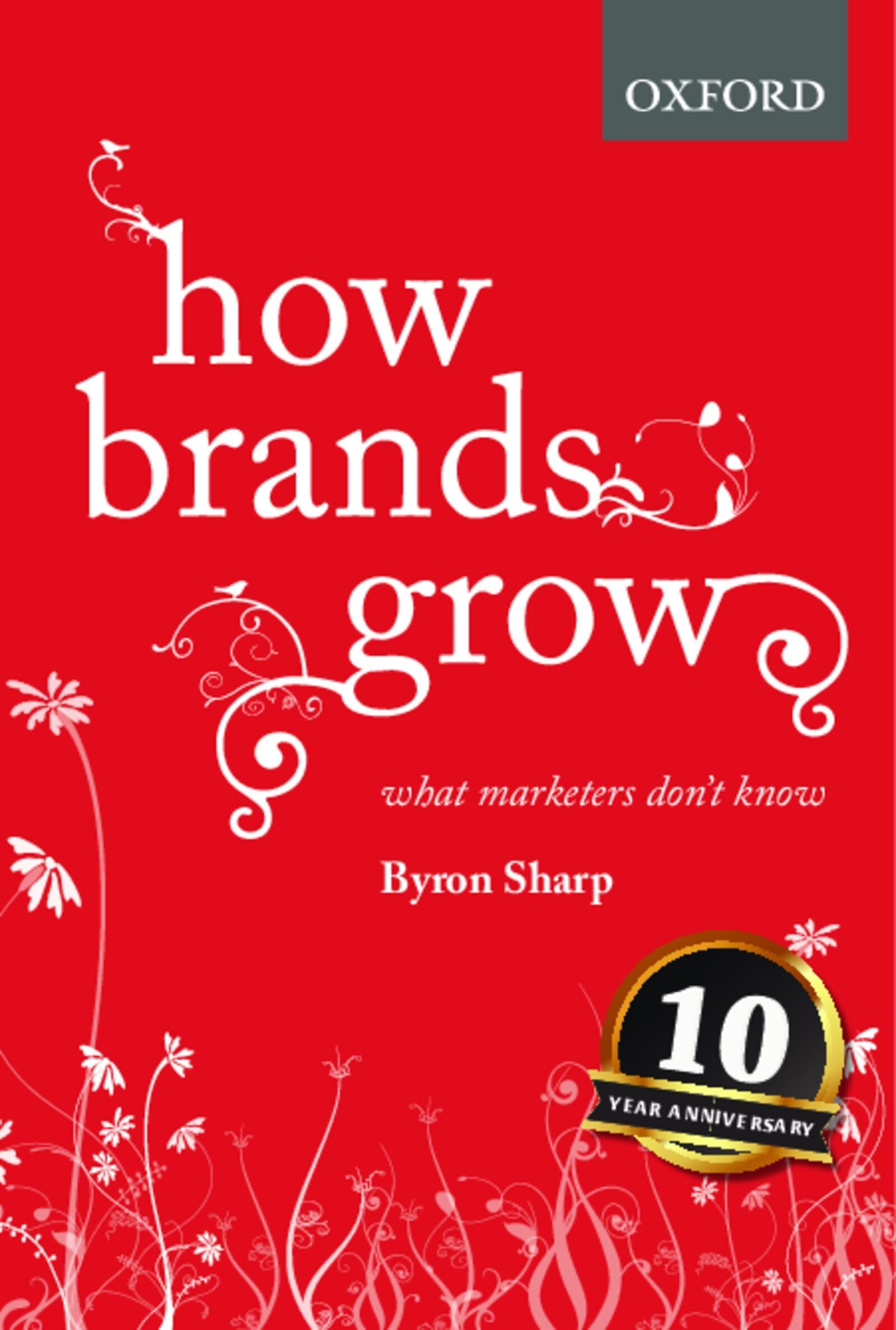
How Brands Grow: What Marketers Don't Know
Desertcart purchases this item on your behalf and handles shipping, customs, and support to UAE.
Description
📈 Crack the code of brand growth with the ultimate marketing manifesto!
- RISK FREE PURCHASE - Enjoy hassle-free returns with our no-quibble policy, because your satisfaction matters.
- RAPID DELIVERY PROMISE - Order before noon and get your copy shipped the very same day—no waiting, no delays.
- EVIDENCE BASED MARKETING MASTERY - Unlock decades of proven research that challenges outdated marketing myths.
- TOP RANKED MARKET RESEARCH BESTSELLER - Join thousands of professionals who trust this #7 ranked book to sharpen their marketing edge.
- ESSENTIAL FOR GROWTH FOCUSED MARKETERS - Discover the new world model of brand growth that prioritizes market penetration over loyalty.
How Brands Grow is a groundbreaking marketing book that debunks traditional theories with decades of scientific research. It reveals that brand growth hinges on increasing market penetration rather than loyalty, offering marketers a fresh, evidence-based framework to drive real results. With same-day dispatch and a no-hassle return policy, this mint condition bestseller is a must-have for professionals eager to stay ahead in the competitive marketing landscape.
Specifications
| Best Sellers Rank | 5 in Market Research |
| Dimensions | 16 x 2 x 24 cm |
| Edition | 1st |
| Isbn 10 | 0195573560 |
| Isbn 13 | 978-0195573565 |
| Item Weight | 612 g |
| Language | English |
| Print Length | 246 pages |
| Publication Date | 11 Mar. 2010 |
| Publisher | Oxford University Press |
Reviews
User
Sharp argues that the Double jeopardy law tells us what our marketing metrics will look like – if we are successful in gaining s
How brands grow is a book largely about fundamental marketing principles: brand growth, how advertising works, price promotions and loyalty programs. It’s a myth-busting classic, filled with scientific discovery so it feels different from the more traditional business textbooks. Sharp successfully tears strips off current marketing practices and likens marketing managers to “medieval doctors, working on impressions and myth.” He pushes this analogy further when he compares much of our modern marketing theory to the practice of bloodletting, which was once regarded as a particularly effective way to “cure” medical ailments.You get the feeling that Sharp really enjoys challenging every single marketing assumption we all have; from the taken as given need to differentiate your brand to the fact that a brand’s consumers are a distinctive type of person, in fact, even the pareto law gets a kicking, gone are the assurances that 80% of sales come from the top 20% of your buyers – according to Byron only slightly more than half of sales come from the top 20% of the brand’s customers, the rest come from the bottom 80% .It’s true to say that by and large this book is somewhat of a manifesto for what he calls his new world model:Past World Model Positioning Differentiation Message Comprehension Unique SellingProposition Persuasion Teaching Rational InvolvedViewersNew World Model Salience Distinctiveness Getting noticed,emotional response Relevant Associations Refreshing andbuilding memory structures Reaching EmotionalDistractedViewsAnd this new world model rests on a very simple premise that ALL brands grow by increasing their market penetration, forget about loyalty and/or anything else. He proves this hypothesis through what he calls the Double Jeopardy Law. Sharp argues that the Double jeopardy law tells us what our marketing metrics will look like – if we are successful in gaining sales and market share.Here’s an example:Shampoo Brands Market Share (%) Annual market Penetration (%) Purchase Frequency (average)Suave Naturals 12 19 2.0Pantene Pro V 10 16 1.9Alberto VO5 6 11 1.6Garnier Fructis 5 9 1.7Dove 4 8 1.4Finesse 1 2 1.4Average 1.7Note: Smaller US shampoo brands suffer from only slightly lower loyalty.If Finesse were to catapult up to the sales levels of Suave Naturals or Pantene Pro V, it would be substantially more popular with millions more households buying it each year. But these households would not, on average buy it much more often than current Finesse households buy the brand.Finesse’s brand manager could plan to reach market leadership by getting current customers to buy eight times a year. That would be enough to do it – in theory. But in practice it’s impossible. As Sharp goes on to point out Finesse buying households currently only buy shampoo six times a year; therefore Finesse would need to command 100% loyalty just to achieve six purchases per year per customer. But no shampoo brand in the US commands 100% loyalty. Such a marketing plan is a fantasy.Double jeopardy, therefore, tells us what is, and what isn’t achievable – sort of a practical guide to strategy formulation.Make your brand famous,make your brand popular.The book continually delivers a strong case for mass marketing, as attested above, Sharp continually hammers home that growth in market share comes by increasing your brand popularity or fame. You do this by gaining many more buyers (of all types), most of whom are light consumers buying the brand occasionally. This allows Sharp to controversially define brands as “undifferentiated choice options of varying popularity.”It’s an easy read, a lot of it planners probably already know as it’s based on the work of Andrew Ehrenberg who in 2003 proved, albeit with shorter term dynamic analysis, that both rising and declining brands displayed more change in their penetration than in their purchase frequency. Sharp adds a level of metric data to the debate which makes Ehrenberg’s theories easier to substantiate. This argument also fits well with the more recent IPA analysis by Binet & Field in 2007 which showed that effectiveness award winners were far more likely to have set targets to increase market penetration.
User
Just what you need to know
It seems sensible, doesn't it, that if you want to grow, you need more customers - new customers. This is the essence of the book, but it over-turns the wisdom that you should spend time, if not money too, concentrating on your existing customer base. A broad, shallow customer base, always growing is the key to brand recognition and business growth. What else the book is saying is that investment on keeping loyal customers is - well, not necessarily a waste of money, but has nothing statistical to suggest that it has any meaningful effect. I have read several books on branding in recent months and each of them has merit, contributing something different to the case and the question - how to grow your business? If you accept that most customers have no inherent loyalty, then constantly seeking new ones, to broaden your base, makes sense. It is logical and unemotional: being a customer, buying your product is probably subject to whim or changing values and expectations and loyalty comes at a cost in terms of vouchers and give-away discounts etc. A brand offers meaning to customers who recognise it but, who may buy a cheaper or more convenient product nevertheless; a recognised brand also helps to capture new customers who help to make your business grow. In a nutshell, this is what the book is saying - it offers more than this and a range of statistical information that puts its arguments into context and makes it convincing; not the only, but one of the best books on the subject I have read and which has set me to work, so it is much more than a merely interesting read.
User
Marketing - finally some evidence
This is an outstanding book for anyone who is interested in selling - which since all business is selling, should be anyone in business.It debunks quite a lot of ideas around marketing - e.g. there is no such thing as loyalty - most big brands are big because they have massive distribution so it makes is more likely consumers will find them on the shelves when they're looking for something in the category. The nice thing is that much of the earlier chapters are backed by reasonable amounts of data (e.g. how easily consumers switch brands, etc) - something that is unusual in marketing.It also ties in nicely with the work of Daniel Kahneman on heuristics saying that, despite having little loyalty, most people only buy things they've heard of (we take mental shortcuts for decisions as Kahneman has comprehensively proved) so you need to make sure people have heard of your brands in the first place if you want to sell it.However, I only give this four stars as in some of the later chapters (e.g. Chapter 9, "How advertising really works") the author suddenly drops his evidence-based approach and goes back to the time-honored marketing approach of making authoritative but evidence-devoid assertions. For example, the now popular idea that you need to create more "occasions" around your brand to grow mindshare clearly come from this book, but no data for it is ever presented.
User
Marketing under the spotlight
I love this book.It's the first book on marketing I've read - and I've read many, many books on marketing - where I was presented with hard, solid data for the claims that are made. Almost all of the other marketing books have relied upon waffly anecdotes and less than scientific 'evidence'.What Bryon Sharp has done is point a very bright light on marketing and branding. By using statistically relevant data, gathered across many different industries and countries, he pulls the rug from under many of the commonly accepted 'hearsay' views of marketing.For example, he shows how dis-loyal loyal customers can be. He pulls apart certain concepts around Differentiation and Price Promotions. He also explains the role that Advertising really plays.But that's not all he does. As Bryon chops away at the hype and puffery, he provides instead a solid and convincing framework for effective marketing and branding.As with others here, I wish more professional marketers would read and learn from this book. As Byron Sharp points out, what we should be moving to is a world of evidence based marketing. And the evidence of - if we apply the lessons of this book - increased sales, revenue and profits.Highly recommended.
User
Now a classic marketing text
The world of AI based search has changed the game in digital marketing, but this book is still relevant.
User
Great
Probably one of the best books I have read on marketing. Mind opener, highly recommend it.
User
Ok
Ok
User
Highly recommended reading for anyone involved in business or brand promotion
Finally, a book on marketing and advertising which gives simple but profound advice. It says things which I've often thought about marketing but which I have never actually seen in print before. Moreover, the authors back up much of their claims with reference to empirical studies. I've finished this book and it has changed the way I think about this whole area. Highly recommended reading for anyone involved in business or brand promotion.
User
A must read for un-learning and re-learning some of the marketing tricks
The book - How Brands Grow, raises a lot of questions. It shakes up our traditional understanding of marketing especially Kotler's theories. Book bust a lot of myths. The author gives enough empirical data to support his claims. I connected with the few concepts like why loyalty program does not work, why price promotion is for retailers and what is the ultimate purpose of advertisement.I could not digest the notion that STP does not work, but got convinced the way he explained. Finally, he sums up by saying that it's only the mental and physical availability that make the brand easier to buy for more people, in more situations and the brand grows.No matter you subscribe to his thoughts or not, reading the book will force you to think about marketing in a slightly different way. It will create a new memory structure for marketing. A must-read for any marketers.
User
Good read for marketers
Good book for people in marketing or brand managers
User
A must-have for any marketer!
Probably among the top 10 best marketing books ever red, along with Consumer connection, Cultural branding, etc.Altough some short-cuts are taken, and some chapters repeat themselves, it is an amazing though-provoking book for anyone who has gone through the dogma books of Kotler & like.
User
A must-read
A must read book for any business leader
User
A great book for marketers
Quite interesting to learn about the appeal of “mass marketing”.
Common Questions
Trustpilot