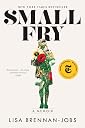
Small Fry: A Memoir
Product ID: 130623482
Desertcart purchases this item on your behalf and handles shipping, customs, and support to UAE.
A NEW YORK TIMES AND NEW YORKER TOP 10 BOOK OF THE YEAR “Beautiful, literary, and devastating.”— New York Times Book Review • “Revelatory.”— Entertainment Weekly • “A masterly Silicon Valley gothic.”— Vogue •“Mesmerizing, discomfiting reading… A book of no small literary skill.”— New Yorker • “Extraordinary… An aching, exquisitely told story.”— People • “The sleeper critical hit of the season.”— Vulture A BEST BOOK OF THE YEAR FOR NPR, desertcart, GQ , VOGUE (UK), BUSTLE, PUBLISHERS WEEKLY, AND INDIGO Born on a farm and named in a field by her parents―artist Chrisann Brennan and Steve Jobs―Lisa Brennan-Jobs’s childhood unfolded in a rapidly changing Silicon Valley. When she was young, Lisa’s father was a mythical figure who was rarely present in her life. As she grew older, her father took an interest in her, ushering her into a new world of mansions, vacations, and private schools. His attention was thrilling, but he could also be cold, critical and unpredictable. When her relationship with her mother grew strained in high school, Lisa decided to move in with her father, hoping he’d become the parent she’d always wanted him to be. Part portrait of a complex family, part love letter to California in the seventies and eighties, Small Fry is a poignant coming-of-age story from one of our most exciting new literary voices. Praise for Small Fry “An intimate, richly drawn portrait… The reader of this exquisite memoir is left with a loving, forgiving remembrance and the lasting impression of a resilient, kindhearted and wise woman who is at peace with her past.”— San Francisco Chronicle “A heartbreaking memoir, beautifully rendered…It’s a love story for the father that she had, flaws and all… A wise, thoughtful, and ultimately loving portrayal of her father.”— Seattle Times Review: A Poignant Emotional Journey with some Baggage - Lisa Brennan-Jobs is a good writer: quick-witted, poignant, and observational. Her style reminds me of her aunt’s (Mona Simpson) novels. This is no surprise, since she mentions her in Small Fry as an inspiration. Also of note, is that her aunt has written a fictionalized account of the same period in Lisa’s life as is largely covered by Small Fry. I read that novel, A Regular Guy, when I was a teenager. In fact, I’ve been reading books about Steve Jobs for about two decades now. Like many readers, Steve Jobs is the reason I picked up Small Fry, but Lisa’s journey resonated with me almost as much as the moments about her father. When you become interested in a historical figure and start watching and reading about them, there’s a cast of characters—their family, their friends—that you’re introduced to along the way. My first exposure to Lisa came through the 1999 film Pirates of Silicon Valley, in which the story of her relationship with her father plays prominently. By the time I had read The Second Coming of Steve Jobs by Alan Deutschman the following year, to me she was an important sidenote—his initial denial of paternity of her following her birth, a significant blemish, for an otherwise heroic figure. The deeper you go in a canon (and there is a Steve Jobs canon—at least fifteen books), the more you become interested in those peripheral characters. And somewhere along the way I became interested in Lisa’s story. Lisa’s story is intertwined with that of her mother, Chrisann Brennan, Jobs’s high school girlfriend, first love, and financial dependent for a large portion of Lisa’s life. She wrote a memoir a few years ago, The Bite in the Apple. So, in actuality we have three books—A Regular Guy, The Bite in the Apple, and Little Fry—which overlap very significantly in the period and relationships that they capture. Each comes from a different perspective, and I think it was likely important to Lisa that she recapture her own narrative through this memoir. It’s not only a chance to correct the record, but also can provide some kind of closure. Ostensibly this is more than a memoir about her relationship with her father. It’s a memoir about growing up with that as a backdrop, but I frankly found the first half of the book pretty slow. That’s probably because there’s less of her father in the first half, and the parts with her father were the parts that interested me the most. Lisa has a tendency to write about events that occurred to her 30 years+ ago in great levels of detail. Levels of detail so great (exact words, imagery, and small happenings) that one has to conclude she either has a photographic memory, or is remembering things in the most dramatic way to suit her narrative. The Bite in the Apple also suffers from this flaw—overly exact ancient memories that cause the reader to question the veracity of their content. It is of course possible that both mother and daughter have incredible memories, but it’s also possible that there’s a little bit of dramatic license in their accounts. Small Fry is emotionally powerful. The story is dramatic enough that even readers more interested in Lisa’s emotional journey than Steve Jobs will get something out of it. Ultimately, as most memoirs by definition tend to be, it’s also one-sided. The low points with her father seem awful, and the high points seem agreeable and fascinating but dulled. Mona Simpson and Laurene Powell Jobs (Steve Jobs’s widow) have put out a statement questioning Lisa’s harsh treatment of her father. I think, in wanting to recapture her narrative, Lisa did have something of an agenda in writing this book, even if she’s not willing to admit it to herself in its pages. However, that doesn’t mean it’s not a good book, that doesn’t take you on a meaningful emotional journey, and further develop your understanding of Steve Jobs. Review: Good Reading for Single Moms and Absentee Dads - Today it is common knowledge that the first three years of a child's life are critical years of development. The author had no contact with her father during those years since her parents never married - so her emotional outlook was exclusively shaped by her (bi-polar?) mother. I found the book interesting because her mother had written a demand letter to Jobs for $25 million - an amount which she felt was "fair" for raising Lisa - and had already penned and released her own version of their collective history (The Bite In The Apple). In Small Fry, Lisa adds her own voice to her mother's neediness for money. Apparently whatever Steve gave them wasn't enough in their own minds - and mother-daughter had no inclination to save and burned through money. Steve recoiled from anyone who he perceived was trying to manipulate him for cash - like most wealthy people - and the constant demands sadly emotionally estranged him - to his own detriment as well as the rest of the family. Love and financial responsibility go hand in hand - and at the end he had sincere regrets. And admitted that he "owed" Lisa... not sure how much money she inherited - or if she in turn financially supports her mother today - but it obviously wasn't enough. And although the book has touching moments, it is hard to visit the editorial choices made without thinking this was an exercise in revenge and literary passive-aggression. Lisa certainly has every right to feel shortchanged by both parents and airs her own perspective, adding incidents that justify her viewpoint. I feel sad that Steve's personal privacy - once more - will be public fodder. He was a complex person, but he is dead now. I kept wondering (since he reportedly left Lisa a multi-million dollar inheritance) if she has already burned through it - along with her mother - and this book is another way to get whatever Steve "owed" them by cashing in on his famous name. Every single mother - and absentee father - should read this book, to understand the child's perspective on being juggled between two parents/two worlds. It is relevant and eye opening. Good lesson about family dynamics and child support. If you want to read about Steve Jobs "Becoming Steve Jobs" is by far the best book I've read about him to date. If you want a cautionary and thought provoking lesson in providing child support and navigating custody and raising kids - this is a good read. Well written. As a single mother myself, I felt for Lisa and her mom - however as someone who knew Jobs through the 1980's and was a start up female entrepreneur (thanks to Jimmy Carter who started an SBA program providing start up loans to women), I also have more compassion for his flaws and personal privacy. He had a lot on his plate and I was glad that Lisa remembered some good times that he shared with her and captured his rare electric charisma. Sad story, but a cautionary tale for all single parents - and certainly worth reading.
| Best Sellers Rank | #170,757 in Books ( See Top 100 in Books ) #247 in Rich & Famous Biographies #1,519 in Memoirs (Books) |
| Customer Reviews | 4.3 out of 5 stars 5,516 Reviews |
D**C
A Poignant Emotional Journey with some Baggage
Lisa Brennan-Jobs is a good writer: quick-witted, poignant, and observational. Her style reminds me of her aunt’s (Mona Simpson) novels. This is no surprise, since she mentions her in Small Fry as an inspiration. Also of note, is that her aunt has written a fictionalized account of the same period in Lisa’s life as is largely covered by Small Fry. I read that novel, A Regular Guy, when I was a teenager. In fact, I’ve been reading books about Steve Jobs for about two decades now. Like many readers, Steve Jobs is the reason I picked up Small Fry, but Lisa’s journey resonated with me almost as much as the moments about her father. When you become interested in a historical figure and start watching and reading about them, there’s a cast of characters—their family, their friends—that you’re introduced to along the way. My first exposure to Lisa came through the 1999 film Pirates of Silicon Valley, in which the story of her relationship with her father plays prominently. By the time I had read The Second Coming of Steve Jobs by Alan Deutschman the following year, to me she was an important sidenote—his initial denial of paternity of her following her birth, a significant blemish, for an otherwise heroic figure. The deeper you go in a canon (and there is a Steve Jobs canon—at least fifteen books), the more you become interested in those peripheral characters. And somewhere along the way I became interested in Lisa’s story. Lisa’s story is intertwined with that of her mother, Chrisann Brennan, Jobs’s high school girlfriend, first love, and financial dependent for a large portion of Lisa’s life. She wrote a memoir a few years ago, The Bite in the Apple. So, in actuality we have three books—A Regular Guy, The Bite in the Apple, and Little Fry—which overlap very significantly in the period and relationships that they capture. Each comes from a different perspective, and I think it was likely important to Lisa that she recapture her own narrative through this memoir. It’s not only a chance to correct the record, but also can provide some kind of closure. Ostensibly this is more than a memoir about her relationship with her father. It’s a memoir about growing up with that as a backdrop, but I frankly found the first half of the book pretty slow. That’s probably because there’s less of her father in the first half, and the parts with her father were the parts that interested me the most. Lisa has a tendency to write about events that occurred to her 30 years+ ago in great levels of detail. Levels of detail so great (exact words, imagery, and small happenings) that one has to conclude she either has a photographic memory, or is remembering things in the most dramatic way to suit her narrative. The Bite in the Apple also suffers from this flaw—overly exact ancient memories that cause the reader to question the veracity of their content. It is of course possible that both mother and daughter have incredible memories, but it’s also possible that there’s a little bit of dramatic license in their accounts. Small Fry is emotionally powerful. The story is dramatic enough that even readers more interested in Lisa’s emotional journey than Steve Jobs will get something out of it. Ultimately, as most memoirs by definition tend to be, it’s also one-sided. The low points with her father seem awful, and the high points seem agreeable and fascinating but dulled. Mona Simpson and Laurene Powell Jobs (Steve Jobs’s widow) have put out a statement questioning Lisa’s harsh treatment of her father. I think, in wanting to recapture her narrative, Lisa did have something of an agenda in writing this book, even if she’s not willing to admit it to herself in its pages. However, that doesn’t mean it’s not a good book, that doesn’t take you on a meaningful emotional journey, and further develop your understanding of Steve Jobs.
B**R
Good Reading for Single Moms and Absentee Dads
Today it is common knowledge that the first three years of a child's life are critical years of development. The author had no contact with her father during those years since her parents never married - so her emotional outlook was exclusively shaped by her (bi-polar?) mother. I found the book interesting because her mother had written a demand letter to Jobs for $25 million - an amount which she felt was "fair" for raising Lisa - and had already penned and released her own version of their collective history (The Bite In The Apple). In Small Fry, Lisa adds her own voice to her mother's neediness for money. Apparently whatever Steve gave them wasn't enough in their own minds - and mother-daughter had no inclination to save and burned through money. Steve recoiled from anyone who he perceived was trying to manipulate him for cash - like most wealthy people - and the constant demands sadly emotionally estranged him - to his own detriment as well as the rest of the family. Love and financial responsibility go hand in hand - and at the end he had sincere regrets. And admitted that he "owed" Lisa... not sure how much money she inherited - or if she in turn financially supports her mother today - but it obviously wasn't enough. And although the book has touching moments, it is hard to visit the editorial choices made without thinking this was an exercise in revenge and literary passive-aggression. Lisa certainly has every right to feel shortchanged by both parents and airs her own perspective, adding incidents that justify her viewpoint. I feel sad that Steve's personal privacy - once more - will be public fodder. He was a complex person, but he is dead now. I kept wondering (since he reportedly left Lisa a multi-million dollar inheritance) if she has already burned through it - along with her mother - and this book is another way to get whatever Steve "owed" them by cashing in on his famous name. Every single mother - and absentee father - should read this book, to understand the child's perspective on being juggled between two parents/two worlds. It is relevant and eye opening. Good lesson about family dynamics and child support. If you want to read about Steve Jobs "Becoming Steve Jobs" is by far the best book I've read about him to date. If you want a cautionary and thought provoking lesson in providing child support and navigating custody and raising kids - this is a good read. Well written. As a single mother myself, I felt for Lisa and her mom - however as someone who knew Jobs through the 1980's and was a start up female entrepreneur (thanks to Jimmy Carter who started an SBA program providing start up loans to women), I also have more compassion for his flaws and personal privacy. He had a lot on his plate and I was glad that Lisa remembered some good times that he shared with her and captured his rare electric charisma. Sad story, but a cautionary tale for all single parents - and certainly worth reading.
J**G
Superlative coming-of-age tale
Living in Palo Alto in the 1980s, we often heard rumors that Steve had a daughter named Lisa for whom the computer was named. No one seemed to know whether this was a true story or an urban legend, and certainly none of us realized that Lisa and her mom lived among us -- going out for dinner to the Good Earth, shopping at Units, cruising down University Avenue. Meanwhile, especially after Steve and Laurene married and more kids came along, we often ran into them: getting dessert at Gelato Classico, buying gifts at Palo Alto Toy & Sport, even roller skating along Homer near Whole Foods. Whatever else we thought about Steve, he seemed like a devoted dad. Except he wasn't. Lots of people are raised by substandard parents. You don't get to choose your mom and dad. For many of us, recovery can take decades or maybe even never. But Lisa, to her unending credit, is able to tell a story that radiates affection despite describing neglect that borders on abuse. She walks us through her childhood and teen years with unstinting candor, including a number of anecdotes that highlight her own missteps. The most affecting scenes are the mother-daughter stories. Chris doesn't seem like a candidate for Mom of the Year, as she leaves Lisa by herself as a young child, brings home a series of boyfriends, moves from house to house, and often loses her temper. But because we see her through Lisa's eyes, our takeaway is the shared adoration between mother and child, and we understand that for all her foibles, Chris fought to give her daughter the best possible life. And in many ways her efforts were stymied rather than supported by the fact that Steve overshadowed their lives, even during the years that he remained detached from them. Lisa is an artist, and her writing is the verbal equivalent of a painting, every detail sharply rendered. For that reason alone, this book is worth a reader's attention. Years ago I read an autobiography written by a poet whose narrative resonated like a poem; Small Fry hits that same note and sustains it. If not for her famous father, her book probably would never have been published, and that would have been a loss to all of us.
H**S
Not sure what this is supposed to be
It was an interesting read, but I'm not sure how I'm supposed to feel about Steve Jobs after reading this. Yes, he said some harsh things, and did some cruel things (although there are two sides to every story and we don't hear his), but some of things she harped on did make me think, seriously? Boo hoo for you - suck it up. (But I think I was raised by a sociopath and that kind of behavior is something I also dealt with, so I might not be the best judge of what's right and wrong in parenting.) Maybe we are supposed to feel conflicted about him after reading it, because in my view, he doesn't come off as 100% monster, which is what other people seem to feel. Later in life, he admitted he didn't handle things well with Lisa when she was younger and he clearly felt terrible about that at the end of his life and said so. It doesn't absolve him of his behavior, but when reading about some of the things he did, I think he was trying to raise someone who wasn't "Steve Jobs' kid" and who knew what responsibility and expectations were. Frankly, her mother comes off worse than he does by a long shot. In some ways, it seems like she expected Jobs to just pay for her forever. Why didn't she spend those years trying to figure out a way to support herself? Then she sells the house he bought her and did nothing for two years, just living off the money? If she had wanted to go to school and get an education that lead to something viable to support herself, he probably would have paid for it, but we just get vague stories of her painting and selling stencils and the constant refrain of "we have no money." I liked the writing, though, and it was interesting to get her perspective. Just thought some of it was teenage drama x 10.
I**N
Steve Jobs the Man
It's hard to read any biography of Steve Jobs that doesn't end up being a history of his work. It's fair to say that for Jobs his work was his life and his life was his work. So biographers dutifully check off his founding of Apple computer, his ouster, his time at NeXT, Pixar, and finally his return to Apple. Some biographies are slanted towards his favor while others document his abusive behavior towards his workers. But Steve Jobs did have a family (albeit one that seems to have taken an extreme backseat to his work) and his daughter Lisa has written an incredible book that focuses on Steve Jobs the father and husband. Lisa was the product of a relationship between Steve and his girlfriend Christine Brennan. For many years Jobs tried to deny paternity before acknowledging Lisa. Lisa did eventually get to know her father ... and that's where the heartbreak of the book lies. No matter what you think of Jobs the businessman, it's hard to read this book and have a good view of him as a husband and father. In later years Lisa even lived with Jobs when she ran into a rough patch with her feckless mother. Jobs was a cold, distant father who turned off the heat in Lisa's room, refused to let Lisa join in family pictures, and used Lisa as an unpaid babysitter while Steve and his wife Laurene went on vacations and weddings. When Lisa went to college they became completely estranged and he cut off payments for her college tuition. The reason? She had invited her mother up for "family weekend" instead of him. Not that Steve's "real family" (it hurt Lisa enormously that he always said he had three kids -- the kids he had with his wife) seems to have gotten a great deal either. He comes across as a domineering and cold husband. Laurene is portrayed as someone who tried at first to make it better for Lisa but ultimately became cold and detached herself. When Jobs was dying of cancer and expressed remorse for his treatment of Lisa Laurene's response: "I don't believe in deathbed revelations." In other words, she knew her husband as well too. Steve's business/work life is hardly mentioned in this book. It's instead an incredible memoir of an unhappy, loveless childhood with a mother who was overwhelmed and a father who was incapable of being a loving parent. The tragic part is that Lisa does come across as Steve's daughter: the little details she adds to her memoir, the photographic memory, the incisive observations -- Steve was famous for applying those talents to building the perfect computer/phone/tablet or crafting the perfect computer animated film.
S**E
A TOUCHING MEMOIR OF LIFE WITH A GENIUS
Lisa Brennan-Jobs, in “Small Fry,” has written a touching memoir of her childhood and relationship with her father, Steve Jobs, the founder of Apple. One might not care to hear about another child and parent relationship. After all, true to form, it’s clearly a cleansing effort by Brennan-Jobs, and somewhat self-serving. But it’s also poignant and emblematic of life with a famous person, warts and all. It’s extremely well written and an inside look at living with a legend. No one could possibly know the real Steve Jobs better than his daughter. She doesn’t hold back her feelings, giving the reader a real insider’s perspective of being raised in unconventional fashion by nonconforming parents. Splitting her childhood between a struggling, manic mother and a stern but fragile father affected her own struggle for identity, something she explains with candor and specificity. Walter Isaacson was personally selected by Steve Jobs to write about his life. Jobs promised not to interfere in any way with the production and, true to his word, did not. The result, “Steve Jobs,” was a true masterpiece, done in a totally neutral manner, which uncovered Jobs’ unwillingness to accept authority, his abrasive personality, and incredible sensitivity. His daughter fully validates these characteristics from the standpoint of a young child caught up in the maelstrom of life with a genius. Everything touched on by Isaacson is even more deeply explained by Brennan-Jobs in this deeply personal revelation. “Small Fry” is shocking and, at times, deeply sad. Amid such turbulence and disarray, the reader will marvel at the resiliency and ability of the author to still produce a lovely testament to a father and child relationship. Through it all shines a true love that never quite reaches the level it could have. I enjoyed this book, was deeply touched by it, and don’t hesitate in recommending it. Schuyler T Wallace Author of TIN LIZARD TALES
J**G
You will read the entire book in one setting.
This is a book that is entertaining as it is hard to read. Sad to say but I was raised by a sociopath and I feel that I had a better child hood than the author did. This book will bring a tear to your eye and well as a few laughs. One of the most heart rending stories is when Steve Jobs finally brings home a NeXT computer for Lisa to have. (She had been wanting one for about a year.) Only to find out that is does not work and he eventually removes it from her room. Let’s face it the guy had a genius for design but he was also a sadist. No doubt about the last one. The book mentions how Stevie baby took the whole family to Hawaii and while enjoying the climate of such a beautiful place he took time out to basically torture a parrot. He was teasing it with food trying to determine if it would learn the lesson not to lean for the food when he dangled it in front of the bird. (Can you imagine how many human beings he performed this exact exercise on in this life time.) Sooo thanks for making the effort to write this book. My parents moved up several notches by the time that I finished reading this master work. (I never thought that would happen.) The most important point of this story to me is….a beautiful lady was able to weather the storm of bad parenting (both by the way) and basically willed herself into Harvard. Ms. Brennan-Jobs you are a survivor and also an inspiration.
C**L
Their most personal moments
Some years ago, I read an essay/article by Lisa Brennan-Jobs about her stay in Italy. At the time, I was curious; but I also love romantic stories in a foreign/travel setting. So when I discovered that the memoir SMALL FRY was being published, I immediately wanted to read it, to know what the author's life had been like. SMALL FRY depicts a side of Steve Jobs that makes me a bit sad and, at times, disappointed. No doubt, he had issues that would have benefited from therapy. To explain away some of his behavior, I've reasoned that he may have seen himself as an agent of change: a Zen master of sorts. My life was directly affected by Steve Jobs. My mom, then an educator and college professor, bought two Apple II pc's. In addition, she borrowed a Mcintosh computer from her college, so that at one point, we had three Apple computers in our house. (Today, the Apple computer is anointed with an elite vibe that approaches cult status; but we do not own one.) In the early days of Apple, my mom had met Steve Jobs. She admired him, believed in the vision of a pc revolution. She convinced me to learn how to use our Apple pc, because she said that it was the future. My mom explained that this gadget would be useful to me, an educational tool I should not miss out on. Somewhat grudgingly, I learned how to use our pc's. Soon, I would use an Apple II pc to type up all my writings and my mom's papers/dissertation. In our home, we paid attention to what Steve Jobs did and said. Back then, we had no knowledge of his personal life and eccentricities. SMALL FRY reveals the personal side of Steve Jobs: he was complicated, flawed, not always likable, but always interesting. Ms. Brennan-Jobs tells her lifestory frankly, filled with the contradictions and vicissitudes of life with "a change agent." You get to see Steve Jobs in his most personal moments: from the circumstances of the author's birth to her father's last days. Although I finished the book a few days ago, I still wonder about the dishwasher incident. It's like a koan or a puzzle. What was he thinking? I am so glad to observe that Ms. Brennan-Jobs vanquished, escaped to university--almost despite her father (who paid her tuition, but otherwise gave little to no help or encouragement). Everyone who reads this book will come away with a sense of what kind of father Steve Jobs was. I won't state my own opinion here: You have to read the book. I will say, though, that Chrisann Brennan--the author's mother, who suffered and sacrificed so much--looks like a saint to me. (I may read her memoir someday.) Having considered converting to Buddhism myself, I realize now that Steve Jobs was probably practicing the Buddhist tenet of non-attachment to people, things and results. But I think perhaps he misapplied it, for too often he seemed either uncaring or cruel. From a Rolling Stone Magazine interview of Steve Jobs, the quote that surprises, impresses, and gives a peek into his life motivations is when he says: "The goal is not to be the richest man in the cemetery. At least, it's not my goal, anyway. . . . In the broadest context, the goal is to seek enlightenment--however you define it." For me, one takeaway from all this personal info is that we don't need to know what Steve Jobs ate for dinner, or why he named a computer "the Lisa", or that he wore tattered jeans most of the time, or the name of his guru, or what kind of car he drove. We don't need to know; but we want to know. This kind of detail I personally find fascinating. (I also recommend the bio by Walter Isaacson.) And the truth is that, if you like and use/used any one of the devices that Apple invented, you will have more than a passing interest in the personal anecdotes that form a segment of their inventor's life. Just be prepared for the truth to be occasionally unsettling. Lastly, I can yet recall that on October 5, seven years ago, I wistfully googled as much information about Steve Jobs as I could. I landed on a "memorial" website, in which thousands of people worldwide had posted their condolences and sense of loss. I, too, made a brief post. Inexplicably, I felt as if I had lost a friend.
M**T
Bellísima colección de memorias que retratan el lado no visible del creador de Apple
Una colección de memorias contadas de una forma muy amena y fresca. Disfruté muchísimo de este libro y del modo en que describe sus vivencias y a su padre desde la mirada de niña (luego adulta) que lo retrata de la manera más humana jamás conocida de él...con defectos de toda índole, momentos de grandeza y egolatría máxima y momentos de hombre minúsculo, torpe... Sin rencores ni ornamentos, un relato concreto y descriptivo de recuerdos y vivencias muy humanas. Si tienes nociones claras de inglés, se puede leer perfectamente porque no usa conceptos demasiado intrincados, difíciles de interpretar en nuestra lengua.
A**E
moving and insightful
I really enjoyed this book and was Mesmerized by the way LBJ described her life growing up with Steve Jobs as a father. Very touching how at his impending demise he did finally admit his neglect and cruelty. Not a bit voyeuristic but an essential truth.
T**O
Amazing relationship
Amazing relation between Steve Jobs and his daughter.
D**D
A surprisingly intense autobiography
The author has written a perceptive, painful book about so many missed opportunities for father and herself to become close, discover each other , avoiding harsh judgements...Steve Jobs was certainly a most complex and tortuous human being, pulling and pushing others continuously, giving sometimes, taking often and we can only be amazed at his daughter Lisa surviving such emotional mayhem. Her mother despite deep psychological turmoil, remained there for her, through the ups and downs of everyday life, providing emotional support , and a lasting relationship flawed as it might have been. Despite all Lisa pulled through - an inner strength she inherited from her father no doubt. Thank you for an impressive portrait of humanity.
A**R
a literary memoir written by a famous tech giant's daughter
This book is extremely well written in a very competent literary style. Those interest in Steve Jobs will want to read this but even those who aren't will enjoy it. Once again, we see that Steve Jobs acted at times like a dirt-bag toward his family. He was a genius when it came to Apple and making money but he was quite the dummy in terms of being a good human being. But her love for her father ultimately shines through. Lucky for him.
Trustpilot
1 month ago
1 week ago