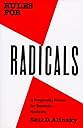
Rules for Radicals: A Practical Primer for Realistic Radicals
Product ID: 1357407
📚Classic radical playbook
🔥Provocative political insights
⚖️Strategic social change tactics
Desertcart purchases this item on your behalf and handles shipping, customs, and support to UAE.
📖 Ignite your impact with the ultimate radical roadmap!
Rules for Radicals by Saul Alinsky is a seminal 1971 guidebook for community organizers and activists, blending sharp political philosophy with practical tactics. This used copy in good condition offers millennial professionals a chance to understand the mechanics of social change from a top-ranked, highly reviewed classic that remains relevant in today’s political landscape.
| Best Sellers Rank | #20,336 in Books ( See Top 100 in Books ) #5 in Elections #5 in Political Advocacy Books #11 in Radical Political Thought |
| Customer Reviews | 4.1 out of 5 stars 4,103 Reviews |
J**E
Know Your Enemy
For over two decades I have watched in horror as our politicians (from both parties) passed laws and regulations that could clearly have no other consequence than the destruction of the USA. Confiscatory taxation, debilitating over-regulation, and job killing pseudo-free trade agreements killed our steel, lumber, oil, auto, textile, electronics and semiconductor industries. The jobs forced off shore historically were the manufacturing jobs average Americans held to raise their families. So why were the politicians resolved to turn our country into a third world banana republic? This question has gnawed at me for over 20 years! In Rules for Radicals, the iconic godfather of radical revolutionaries, Saul Alinsky, supplies the answer! While the chapters on tactics are eye-opening, humorous, and insightful, it is the first half of the book about the community organizers' motivations and temperament that are the most important and illuminating for me. According to Saul, a Radical Revolutionary goes by the handle of "community organizer (CO)." A community organizer is highly intelligent, has an absolutely unquenchable driving compulsion to CREATE, but unfortunately has no talent other than rhetorical skill and a superb natural ability to dupe, bamboozle, trick, and manipulate groups of poor people. Alinsky clearly outlines that: The only things COs can create are chaos, discord and mayhem. Since they are OBSESSED to create and since chaos, discord and mayhem are the only things they CAN create, chaos, discord and mayhem become their only function in life. Everything else shrinks to insignificance - including power, money, love, politics, everything. Furthermore, in their malignant creativity: 1) Politics is merely a rationalization for their destructive actions. Feigned compassion for the poor is merely an excuse for COs to create chaos, discord and mayhem. 2) Politics only matters in so far as class envy and class warfare are most easily generated by embracing a far left philosophy, but to the CO capitalism would be just as good an excuse if it could be used to motivate a target group. Alinsky actually ridicules communism in the book. 3) "The common good" ALWAYS supersedes "individual freedom and liberty." 4) The Ends can ALWAYS justify the Means. 5) Morality is a quaint myth. 6) Action without thought is FAR preferred to action after thought. 7) Environmentalism is the excuse/issue to use to rally the middle class to create new and expanded chaos and mayhem of over-regulation. 8) An unending series of bogus issues must be manufactured to supply continuous fuel for the CO's "creative" obsession. 9) One result of the CO successfully "dealing" with issues is that power changes hands. COs do not want the power, and are more than happy to let any old schlock politician have the power that the CO has made available. So the newly empowered politicians make destructive laws to placate the organized group howling about an issue that the community organizer could not have cared less about but was only used an a means of rallying his army. So that's why we've been suffering through two decades of destructive irrational laws and regulations being passed by schmuck politicians. I don't like the answer to my question. At least now I know what has been happening, so I can start to take counter-revolutionary action. Thanks for the education, Saul! And who else would dedicate his book to the first community organizer, Lucifer?! I HIGHLY recommend EVERYONE read this book.
D**R
A book everyone concerned about current policy direction in the US must read!
Saul Alinsky wrote in 1971 the premiere manual on how to get your voice heard and impact social change. Not only do I recommend the book, I strongly encourage anyone who is concerned about the path of our country to read, dissect, analyze, and apply the suggestions in this classic book. I am so convinced that the book is good, I am giving my own name, not hiding behind a psuedonym or pen name.
Z**N
Contemporaries Seem to Be Lacking the Gear for this Kind of Activism
Saul Alinsky developed quite the reputation for himself in the 50s and 60s as a political organizer, at a time when American society was noticeably more cohesive, and where there was much better dependability of employment. His efforts were greatly focused on Civil Rights, the Anti-War movement, and unionization. In the fifty years since then, there have been entire generations of African-Americans who have left the previously segregated communities and have come to participate in a much more multi-racial middle class. Furthermore, the grand unifying movements of the 1960s have been replaced by a much more fragmented society where collective action seems to be increasingly difficult. Union membership, over the last 35 years, has declined from one in five in the workforce, to a little more than one in ten. With the precipitous decline in manufacturing work (following a similar trajectory, from about in one in five workers to a bit under one in ten), this suggests that much unionization remains present in the public sector, so that those workers enjoy both the amplified job security and benefits funding, along with the additional layer of advocacy afforded by the unions. While Alinsky was heavily involved with anti-war activism, that begs the question that military employment itself, which has traditionally been an avenue of employment stability out of the working class, has itself diminished over time. At the height of the Vietnam War, the total number of service members in Vietnam (about 550,000) was higher than the current number of service members on active duty with the Army alone. Throughout the private sector, jobs usually last under a decade and, while many still have well put together benefits packages, the defined benefit pension has all but completed disappeared. This has lead to an awkward situation where the public sector, funded obviously by tax levies on all workers regardless of sector, is actually preferable to the private sector for the average member of the workforce. Toward the beginning of the book. Alinsky puts forth that much of his experience was among the bottom 40% of income earners (who would earn 30-60K per year in current dollars), and while that remains a very adequate income for a household of one person in the overwhelming majority of markets, that also clearly indicates that marriage and family has diminished sharply among those below the upper middle class. Elizabeth Warren has an excellent video entitled 'The Coming Collapse of the Middle Class' where she runs the numbers for households of like composition in 1970 and 2005. The cost of housing alone has close to doubled, day care was not a thing in the early 70s, forty years ago completing a bachelors degree in almost any subject was a worthwhile project (where as now the cost has increased by 250%, again adjusting for inflation, and frequently graduates are encumbered by debt that averages over $30,000 for degrees in the social sciences and liberal arts that generally do not have a clearcut home in the real economy). Alinsky describes that 'the responsible organizer would have known that it is the establshment that has betrayed the flag, while the flag, itself, remains the glorious symbol of America's hopes and dreams.' While there are still many millions of Americans who remain quite patriotic, those hopes and dreams are increasingly out of reach in a much more fragmented work force and society. English language fluency itself, while still a reality for the overwhelming majority of Americans, is increasingly challenged by the larger and larger Mexican subculture that does not see itself as wholly American. Vast swaths of the southern border territory have become majority Spanish-speaking and ever as far north as Yakima, WA one can find large municipalities that are 30% hispanic. This is not that people of those backgrounds cannot be fully functioning members of American society, but that the sheer cultural force of these numbers is changing what it means to be American. Alinsky goes on to describe that 'any revolutionary change must be preceded by a passive, affirmative, non-challenging attitude toward change among the mass of our people. They must feel so frustrated, so defeated, so lost, so futureless in the prevailing system that they are willing to let go of the past and chance the future.' This nation has travelled relatively deeply into this phase of cultural and linguistic separation that over the next two or three generations could imperil the sovereign integrity of the US. Furthermore, this citzenry has already travelelled beyond the 'security of familiar experience.' This is a time of low unemployment, and we are already witnessng increasing rates of mass casualty incidents, and the disruptive activities of the Black Likes Matter movement in recent years. BLM seems to have gone so far as to advocate for violence against police officers. While the DJIA is approaching 20% of its most recent highs, thus suggesting a bear market could be in the works, any related losses in the work force could easily be six or twelve months away. With the unemployment rate currently a bit below 4%, it is not pleasant to imagine how much social protest and mass casualty incidents will take place when the unemployment rate is just 6% (which would approximate the unemployment rate during the dot-com downturn, which was not even technically a recession). Fifty years ago, people generally were somewhat more disciplined, somewhat better integrated into actual, real-time communities, and employment was generally longer-lasting and provided better purchasing power. To quote Alinsky directly: 'citizen participation is the animating spirit and force in a society predicated on voluntarism.' In the last eighteen months, Bret Weinstein, by any stretch a liberal democrat with a deep commitment to the progressive left as he understood/understands it, was essentially driven from a tenured faculty position at Evergreen State College in Washington State. He had communicated some principled disagreements to a 'day of absence' where non-hispanic whites were actively encouraged to not be on campus for a day, via a distribution list to faculty and student leadership. For two or three days, the campus was taken over by student mobs, the senior-ranking administrator instructed the campus PD to disarm and stand down, and somewhat later Weinstein's wife was also pressured to leave. By any stretch, Weinstein was and remains an active citizen dedicated to 'the democratic dream of equality, justice, peace, cooperation, equal and full opportunities for education, full and useful employment, health, and the creation of those circumstances in which man can have the chance to live by values that give meaning to life.' This really does seem to be a time when the political left, with movements such as BLM mentioned above, and also Antifa, is becoming deeply undemocratic. While Alinsky clarified that 'it is a world not of angels but of angles, where men speak of moral principles but act on power principles; a world where we are always moral and our enemies always immoral,' these groups do not seem to have an end-state in mind. While I am not at all conflating the perspective of someone like Weinstein with the agenda of the Unite the Right Rally, it is perhaps ironic that the organizers of the UTR Rally were very careful to file all the correct paperwork, get the needed permissions, and even sought out the guidance of the ACLU, and then these law-abiding right-wing whites were subjected to the mob violence of the counter-protestors. Since when do civil libertarian left-wing jews and ACLU-consulting white ethnonationalists get subjected to the same type of harrassment from left-wing movements and mobs? Alinsky goes on to describe that 'the man of action views the issue of means and ends in pragmatic and strategic terms. He has no other problem; he thinks only of his actual resources and the possibilities of various choices of action. He asks of ends only whether they are achievable and worth the cost; of means, only whether they will work. To say that corrupt means corrupt the ends is to believe in the immaculate conception of ends and principles. The real arena is corrupt and bloody.' Certainly, what happened at Evergreen State and at the Unite The Right Rally were bloody messes, and yet it seems that the antagonists were lacking in any strategic aim. There was no aim but to silence the opposition by any means necessary; of all things Bret Weinstein has become a regular with center-right commentators like Tucker Carlson, Joe Rogen, and David Rubin. Weinstein has started discussing the development of an 'intellectual dark web' of people who have become increasingly disenfranchised from the authoritarian left. Pertinent examples are given for the pragmatic tactics that are consistent with Alinksy's method, such as Lincoln's suspension of habeas corpus, refusal to emancipate slaves in states where he actually had control, incarceration of political opponents, and usage of military tribunals to make judicial decisions. Similarly, he gives the example that the Indian federal government criminalized the kind of passive resistance that Gandhi's movement had practiced shortly after Indian independence. With that said, none of that is with the political left devouring its own or with ardent right-wingers consulting with a flagship civil liberties organization. There is no apparent strategy here except to shut up the opposition. This book does not advocate simply for civil discourse: 'Power is the very essence, the very dyname of life. It is the power of the heart pumping blood, and sustaining life in the body. It is the power of actual citizen participation pulsing upward, providing a unified strength for a common purpose.' This type of unified action is less and less feasible in contemporary circumstances. Employment situations are too fragile, the wages earned are sorely needed to cover debt repayments and escalating housing expenses, the citizenry is increasingly diverse (unless the activist is a well-integrated, and *bilingual* schizoid, but then rally speeches will take all the longer), people are able to escape into their own on-line enclaves, the mass protest movements seem to be taken out of Idiocracy, and lacking the frustration tolerance to cope with anything Alinsky had been discussing. The characteristics of the talented organizer are given as: curiosity, irreverence, imagination, a sense of humor, a bit of a blurred vision for a better world, an organized personality, a well-integrated political schizoid, ego, a free and open mind (and political relativity), constantly creating the new out of the old, and communication. This last one is particularly important, and all the more challenging in contemporary America. There is simply far greater diversity than was the case a half century ago. The building of a broad-based political coalition is therefore more demanding, and arguably vast swaths of the American populace are too intimidated by the realities of their circumstances to organize for positive change (as discussed above, with the duplicity of employment, diminished purchasing power, increased escapism, and increasing linguistic diversity). Rapport with one's constituency is very important and also more difficult to achieve. Alinsky also argued for a sharply self-critical tendency, so as to build an increasingly effective movement. What such a movement would be right now is up in the air (perhaps broad-based advocacy for those in their mid-thirties through the mid-fifties to reshape the retirement and health care schemes, which are increasingly untenable, such as the replacement of defined benefit pensions with defined-contribution 401K and 403B plans; that still begs the question, though, of people willing to put their necks out when employment itself is that much more uncertain). The author of this book provides some important clarification: 'An issue then is something you can do something about, but as long as you feel powerless and unable to do anything about it, all you have is a bad scene.' Consistent with the discussion above, much of American society seems like a bad scene. Alinsky was advocating for a strategically minded, self-correcting movement for social change, and much of the attention span of the citizenry seems too collapsed for this. Along these lines, Alinsky describes that jail terms of activists that exceed sixty days have two risks: 1.the revolutionary is removed from action for so long that he loses touch; 2.if you are gone long enough everybody forgets. Perhaps this timeframe could be reduced to thirty days for the same guidance to apply, because with instant access to information people generally have less patience and a reduced time horizon for commitment to a social change movement. This is sad because with the increased damage to the middle class there is increased consolidation of financial assets with the 1% and vast portions of the workforce are clinging tenaciously to what work and resources they have in order to avoid hardship Moving on, the income ranges for different socio-economic tiers can be translated into current dollars: 40-75K for the lower middle class, 75-125K for the middle middle class, and 125K-200K for the upper middle class. A simple inflation adjustment does not include the other factors mentioned, such as housing cost, education cost, reduced retirement prospects, increased indebtedness from education and consumer credit purchases, and the curtailed length any individual job will last. To a fair extent, Alinsky seems to have been assuming an underlying stability to the American economy and society that permitted a lot of the activities in which her participated fifty years ago. That was not a time when white collar work could be outsourced to another continent, and the majority of people with jobs could assume coverage by pension programs. There is a certain courage his approach took, and that type of courage may well be lacking in this day and age. Alinsky gives a detailed description of the lower middle class that is worth repeating here (and remember this book was published in 1971): With a few exceptions, such as teachers, they have never gone beyond high school. They have been committed to the values of success, getting ahead, security, have their 'own' home, auto, color TV, and friends. Their lives have been 90 percent unfulfilled dreams. To escape their frustration they grasp at a last hope that their children will get that college education and realize those unfulfilled dreams. They are a fearful people, who feel threatened from all sides: the nightmare of pending retirement and old age with a social security decimated by inflation; the shadow of unemployment from a slumping economy, with blacks, already fearsome because the culture conflict, threatening job competition; the high cost of long-term illness; and finally with mortgages outstanding, they dread the possibility of property devaluation from non-whites moving into their neighborhood. They are best by taxes on incomes, food, real estate, and automobiles, at all levels - city, state, and national. Seduced by their values into installment buying, they find themselves barely able to meet long-term payments, let alone the current cost of living. Victimized by TV commercials with their fraudulent claims for food and medical products, they watch the news between the commercial with Senate committee hearings showing that the purchase of these products is largely a waste of their hard-earned money. Repeated financial crises result from accidents that they thought they were insured against only to experience the fine-print evasions of one of our most shocking confidence rackets of today, the insurance racket. Their pleasures are simple: gardening a tiny back yard behind a small house, bungalow, or ticky-tacky, in a monotonous subdivision on the fringe of suburbs; going on a Sunday drive out to the country, having a once-a-week dinner out at some place like a Howard Johnson's. Many of the so-called hard hats, police, fire, sanitation workers, schoolteachers, and much of the civil service, mechanics, electricians, janitors, and semiskilled workers are in this class.' Please take into consideration that this profiles a lower middle class that was characterized by much greater stability than is generally the case today. The overwhelming majority of people got married relatively young and frequently stay married; divorce was relatively rare and an out-of-wedlock birth was similarly rare and met with considerable shame, both among blacks and whites. A single income earner could afford a consistent, albeit austere middle-class life. That is far from the case today. The majority of births in the black community are out of wedlock, the rate of illegitimacy among whites now exceeds that of blacks from fifty years ago, employers change every five or eight years, both blacks and whites are concerned about an increasing tendency away from an English-speaking worforce and society. These days fewer people get married, people generally get married later in life, the number of workers per social security recipient is collapsing (the Social Security Administration is forecasting that at some point in the 2030s or 2040s that less than 80% of expected benefits will be paid due to shortfalls from payroll taxes, and that has nothing to do with inflation). People are living longer and that exacerbates the cost of health coverage, more people are obese which comes with its own health risks. Long story short, this books seems like a curiosity from a previous era when people had a stronger sense of hope and when the United States was more resilient, socially, economically, and politically. While there were definite concerns back then, in some ways greater than today, the overall structural changes in the society and economy do not seem as amenable to this tenacious, thoughtful form of activism. America is much more diverse, the middle class is much more frail, people generally live more isolated lives, people cling desperately to the jobs that they have with diminished purchasing power and prospects for old age, people lead their lives with a shorter time horizon, and the broad unifying movements seem to be lacking. Of all possible situations, where the white ethnonationalists of the Unite the Right Rally were careful, law-abiding, and sought the guidance of the ACLU, and the thuggery of Antifa received broader support. As mentioned above, with unemployment at one of its lowest points in the last few years there is still an increasing tendency toward mass casualty incidents and feckless racial populism. As a nation, what are we going to be facing when the unemployment rate is 6%?
C**N
Power is held in two places: money and people. No two organizational fights for change are the same!
Power is held in two places: money and people. The wealthy elite class, otherwise known as the “Haves,” wield power via their money; for the rest of us, the “Have-Nots,” power can only be found in organizing together as a united people. The first step to revolutionary change is reformation, which is when masses of people have “reached the point of disillusionment with past ways and values. They don’t know what will work but they do know that the prevailing system is self-defeating, frustrating, and hopeless.” I believe we have reached such a boiling-point in America (and in many places around the world), and people are ready for change. This book is an excellent place to start in our education of what steps to take next. The task of a social organizer is to “inseminate an invitation for himself, to agitate, introduce ideas, get people pregnant with hope and a desire for change,” and to identify themself as the person most qualified for this purpose. A key element of this is the invitation—a group of people who want radical change aren’t going to follow just anybody into a fight, the organizer must first prove they are worthy. The best way to do this is to “maneuver and bait the establishment so that it will publicly attack him as a ‘dangerous enemy,’” Alinsky writes. The word ‘enemy’ identifies him or her with the Have-Nots, while the word ‘dangerous’ reveals the establishment’s fear of the organizer. Through this reaction of the establishment, the people will see that the organizer is on their side in their fight for change, and only then, once he or she has their ‘birth certificate,’ can the real work begin. Their first job is to create a coalition comprised of members who care about a wide variety of issues so as to incorporate the most amount of people possible and increase their organization’s power. It is important to have members that care about different issues so that the fight is never dead. If one issue is being held at a standstill, there is always another avenue that can be exploited. So, what does an organizer actually do to create the changes their people desire? They put pressure on the establishment via whatever tactics are appropriate and available to them at the time and place of their fight. There is no tactic that works everywhere and always—all tactics are situational. Are you a group of tenants organizing against a landlord for better living conditions? Perhaps you all withhold your rent payments at the same time. Are you a group of auto-workers organizing against your employer for better wages? Perhaps you all go on strike. Are you a group of college students organizing against your administration because they don’t allow bikes or skateboards on campus? Perhaps you all chew a tremendous amount of gum and leave the chewed pieces stuck all over the sidewalks in protest. Whatever the tactic, it should hopefully be something the people enjoy! The rush of ‘sticking it to the man’ is one that pretty much everybody can get behind. Then, once the initial tactic is performed, you wait and see what the establishment’s reaction is. “Accident, unpredictable reactions to your own actions, necessity, and improvisation dictate the direction and nature of tactics,” Alinsky writes, “then, analytical logic is required to appraise where you are, what you can do next, the risks and hopes that you can look forward to.” Let’s say we are the students chewing gum on campus in protest against the administration. We leave the gum stuck everywhere, but we don’t get what we want: bikes and skateboards are still not allowed. Perhaps we change our tactics again and organize a day when nobody goes to classes and instead stands in front of the administration building with signs and bullhorns and someone makes a call to the local news station to gain wider attention for our issue. The reaction of the administration to this new and alternative tactic will once again dictate what we do next. Alinsky spends considerable time discussing means and ends and the morality and ethics attached to each and his conclusion is simple: it depends on the context. “Means and ends are so qualitatively interrelated” he writes, “that the true question has never been the proverbial one, ‘Does the End justify the Means?’ but always has been ‘Does this particular end justify this particular means?’” This, of course, depends on both the situation itself and the moral decision making of whoever is suggesting a particular means. There are a few iron laws that come with this subject: in war, for example, the end justifies almost any means. Furthermore, in any context, one’s concern with the ethics of means and ends varies inversely with one’s personal interest in the issue—do you stand to gain or lose? Depending on whether it is the ‘Haves’ or ‘Have-Nots’ who are sitting in judgment will determine whether a particular means is determined to be ethical or unethical. The road to social change is not a nicely paved one straight up the mountain to the top. Instead, it is a twisting path filled with switch-backs and dead-ends. In essence, there is no map, only the guiding words of a man who has climbed plenty of other mountains before, but not the mountain any of us find ourselves facing right now. All mountains are different, the same way all organizations of people and the issues they face are. This book is a wonderful guide, but it is up to us to blaze our own trail forward.
A**L
Communist Ideology Under Another Name
The title almost says it all, but he is specifically talking about liberal (progressive) radicals. Mr. Alinsky says he isn't a communist and gives lip service to wanting to increase the participation of people in the democratic process. He claims to avoids violence. Nice things to say, but when you read the book you quickly discover these are lies. The author tells us history is always progressing. At each stage of history there is a clash of ideas, and then the ideas meld, and another stage of progress begins. This is, of course, Hegel’s theory of the dialectic. Communist all the way. Then he divides society into three classes (The haves, the have nots, and the have a little want more), which is exactly what all communist do. The theory of class warfare is alive and well in these pages. Then we discover how little the individual means to him: “We now live in a world where no man can have a loaf of bread while his neighbor has none. If he does not share his bread, he dare not sleep, for his neighbor will kill him. To eat and sleep in safety man must do the right thing, if for seemingly the wrong reasons, and be in practice his brother’s keeper.” Rules for Radicals (p. 23). Kindle Edition. This means what I work for is not mine and will be taken by force to give to someone else. That is pure communist thought. Although he talks about means verses ends the result is an examination of the particular ends vs. the particular means. Thus, he endorses violence to achieve a goal if the group seeking the goal decides violence is justified. The author goes through a lot of historical fluff to explain this result, but it is pure communism. Communism embraced violence to achieve its ends from the first. In fact, violence was necessary and desirable. This was the foundation for Stalin’s murder of millions of Russians who did not support his regime. Alinsky’s regimes will lead to the same place, mass murder, but he refuses to acknowledge that fact. Alinsky writes as if he can take or leave religion; however, he bad mouths it at every turn. He finally argues that Christian- Judaeo religion tells us that disregard for the well being of others is immoral. This is wrong in the context he presents the argument. The author is saying it is immoral for The State (group) to ignore the well being of others. Christianity never tells the State to act on behalf of the well being of anyone. Only the individual is encouraged to act to help others. It is an outright lie to say Christianity tells the State to act on behalf of the well being of others. He finally rejects the concept of the importance of the individual by saying the individual is his own worst enemy, thus, the idea of the individual being greater than the State must die. The majority of the book is taken up with how to organize people to influence the government, and he is prone to encourage lying whenever necessary to achieve the murky goals of justice, morality, and order. In fact, the goal is communism by any means necessary including outright violence. He uses techniques taught by Linin and the communist international movement. Thus, the book is a lie from the start because it attempts to hide its true goals through misdirection of language. His real purpose lines up perfectly with communist teachings since the publication of the Communist Manifesto. The results of communism are clear for anyone to see. Millions upon millions killed in the name of "progress." In fact, the idea that the individual is greater than the state is the only political ideal that has ever brought freedom to anyone. Every other path leads to tyranny and murder on a vast scale. AD2
J**D
Alinsky's rules for destroying capitalism have succeeded beyond his wildest dreams.
So successful have radical front groups such as ACORN been, that it may not be long before the very same tactics can be used against the radicals themselves. Saul's tactics of intimidation, civil disobedience, threats, veiled threats, strikes, boycotts, lying, bluffing, more lying, fixing elections, infiltrating all layers of government, media manipulation, fear, smears, ridicule, hit & run tactics, humor and "dirty pool tricks" of all kinds were always intended for the "have nots" to use against the "haves." Now that the radicals have actually gained so much power, they are no longer the "outside have-nots" and the very same strategies they used to gain power can be turned on them. While the radicals will have succeeded in forcing most multi-national corporations to move their businesses and jobs off shore, their socialist policies will no longer be able to raise enough taxes to produce the Socialist, Communistic Utopia that was promised. It will be interesting to observe taxpayer revolts where suddenly almost everyone is showing no taxable income. It will be fascinating to see millions of formerly middle class citizens suddenly and all at once decide not to pay their real estate taxes. It will be enlightening to see government offices swamped with citizens applying for every possible entitlement all at the same time and over and over again. The unemployed will simply refuse to work full-time. Tax payer lawsuits will overwhelm the court system and the IRS. While the majority of citizens have willingly paid their income taxes in the past believing they owed it to their nation for it's freedoms, the critical mass of real fairness will quickly be reached and the majority of the formerly law biding citizens will start to cheat on a massive scale. The American way of life isn't going to go down the drain peaceably and the voters, once they figure out how they have been tricked, will be ready for another revolution to restore the freedoms that they so easily surrendered to smooth talking snake oil salesmen. When both sides start applying these rules for radicals the resulting polarization will be more pronounced than anything the United States has ever experienced other than the Civil War. This is an excellent primer for Americans to read to better understand how they have been tricked, and how to go about returning the favor to those who did the tricking. The black markets and underground economy may smother the legal economy and unreported cash and bartering will once again become king. I found insightful some of the author's opinions of how shallow liberals are and how they must be treated with kid gloves and only included in quick, easy, symbolic actions because of their short attention spans and because of their low tolerance for even modest sacrifice. He considered them mostly radicals in theory and talk only. His sage advice not to try these tactics in Russia, China or Havana unless the radicals and all their friends wanted to be tortured and killed was enlightening as well. Old Saul was obviously depending on the fact that freedom of speech would not be entirely eliminated in America because if the radicals managed to destroy free speech, they might find themselves on the wrong side of a Cuban-like dictatorship. He obviously didn't plan on causing so much damage to American Corporations that they went bankrupt. He didn't want to kill the golden goose, he just wanted to own and control it. This is a fascinating read for political junkies. It's amazing how the same tactics may so easily be used to turn the tables on the folks originally employing them. One of the most interesting parts of the book to this reviewer was how to use humor to defeat your enemies. The idea is to make them a laughing stock. Humor can be utilized to make points much more effectively than straight, serious discussion. One only has to watch the late night talk shows and SNL to see how powerful humor can be in influencing elections, especially in this era when many people no longer read the print media and get much of their news from the jokes of their favorite late night talk show hosts.
T**E
We are Being Played; Know the “Rules” of Their Game or the US & Our Constitutional Republic Loses
Updated December 2016 Saul Alinsky’s “Rules for Radicals” is a widely used primer for organizers trying to create social change and political justice. These “rules” have also been adopted by many national, state and local politicians in their quest for power or support for issues which may not have anything to do with social change. Alinsky was a Chicago-born archaeology major who, in the midst of the Great Depression, dropped out of graduate school and became involved first with the labor movement and then with community organizing. He has experienced unusual notoriety in recent years due to his connection with presidential candidate Hillary Clinton and alleged connection to President Barack Obama. Clinton interviewed him and wrote her senior thesis, "An Analysis of the Alinsky Model," while at Wellesley. Critics of the President (who also worked as a community organizer in Chicago prior to embarking on his political career) often link his name with that of Saul Alinsky, sometimes in ways that suggest the two men knew each other and worked together. While untrue, there is some evidence he did teach and practice Alinskian methods to create “change” as an organizer. With an understanding of the “Rules” and a look back over the past 20 years, we will see that they are being employed by a vast number of “organizers” across all political interests to “divide and conquer” in a quest for power and support. Disruption of meetings and creating fear are two of Alinsky’s most visible trademarks: using spectacles – fighting, vulgarities, and incessant interruptions – to make up for a lack of numbers; targeting an individual to make a large point; and using ridicule to persuade the undecided. All were visible in the 2016 Presidential Election cycle. Alinsky, who died in 1972, explained that his book was concerned with how to create mass organizations to seize power and give it to the people. “What follows is for those who want to change the world from what it is to what they believe it should be. ‘The Prince’ was written by Machiavelli for the Haves on how to hold power. ‘Rules for Radicals’ was written for the Have-Nots on how to take it away.” The “Rules for Radicals” outlined by Alinsky are: 1. “Power is not only what you have, but what the enemy thinks you have.” Power is derived from money and people. “Have-Nots” lack money so they must build power from flesh and blood. 2. “Never go outside the expertise of your people.” It results in confusion, fear and retreat. Feeling secure adds to the backbone of anyone. (Consider how organizers start by getting ‘the people’ to see them as one of them. Obama did this shortly after becoming President when he attacked a Cambridge police officer, without any facts, for arresting a black Harvard professor. We learned later that the officer was correct in his arrest. That was a non-issue for the President as he used this incident to let Blacks everywhere know he was one of them and he understood their fears.) 3. “Whenever possible, go outside the expertise of the enemy.” Look for ways to increase insecurity, anxiety and uncertainty. (Consider Donald Trump’s characterizing opposing candidates like an editorial cartoonist by emphasizing one outstanding trait – “Crooked Hillary,” “Little Marco,” etc. This approach was well outside the norm for political battle, and put those who were targeted on defense.) 4. “Make the enemy live up to its own book of rules.” If the rule is that every letter gets a reply, send 30,000 letters. You can kill them with this because no one can possibly obey all of their own rules. 5. “Ridicule is man’s most potent weapon.” There is no defense. It’s irrational. It’s infuriating. It also works as a key pressure point to force the enemy into concessions. (Obama, Clinton, Trump, and Harry Reid are all guilty of using ridicule.) 6. “A good tactic is one your people enjoy.” They’ll keep doing it without urging and come back to do more. They’re doing their thing and will even suggest better ones. 7. “A tactic that drags on too long becomes a drag.” Don’t become old news. 8. “Keep the pressure on. Never let up.” Keep trying new things to keep the opposition off balance. As the opposition masters one approach, hit them from the flank with something new. (Consider flank attacks by Democrats with charges that Candidate McCain had an affair, and then the release of the “Access Hollywood” video painting Trump as a molester.) 9. “The threat is usually more terrifying than the thing itself.” Imagination and ego can dream up many more consequences than any activist. 10. "The major premise for tactics is the development of operations that will maintain a constant pressure upon the opposition." It is this unceasing pressure that results in the reactions from the opposition that are essential for the success of the campaign. 11. “If you push a negative hard enough, it will push through and become a positive.” Violence from the other side can win the public to your side because the public sympathizes with the underdog. (Consider Clinton’s charge that temperamental Trump was unfit to serve, and Trump’s charge that “crooked” Hillary was unfit to serve. And Senator Harry Reid’s aggressive approach to almost any issue and Hollywood’s romanticizing of provocative issues.) 12. “The price of a successful attack is a constructive alternative.” Never let the enemy score points because you’re caught without a solution to the problem. 13. “Pick the target, freeze it, personalize it, and polarize it.” Cut off the support network and isolate the target from sympathy. Go after people and not institutions; people hurt faster than institutions. (Consider what we are witnessing with just about every Trump appointee…racism, fascism, xenophobia, etc.) Alinskian methods work. They have been widely adopted in the quest for power by politicians, Hollywood, interest groups and other organizations with vested interests. They have contributed to today’s absence of any fundamental Truth, and the resulting absence of productive political discourse. Moral relativity is the only truth and from this comes political correctness, gender conflict, gender confusion and so many other confusing aspects of US culture that had at one time been anchored in Truth. These methods, though, create the very unrest and disparities that those who use them claim to be fighting against. One of many troubling aspects of Alinsky’s philosophic approach centers on the notion of “means and ends.” “Means and ends are so qualitatively interrelated that the true question has never been the proverbial one, ‘Does the End Justify the Means?’ but always has been ‘Does this particular end justify this particular means?’…THE END JUSTIFIES ALMOST ANY MEANS.” Moral rationalization is indispensable at times of action…to justify the selection for use of means and ends.” This philosophy made national news in 1996 when Vice-President Gore’s role was exposed in a money-laundering scheme involving the California-based Hsi Lai Buddhist temple. Gore admitted his mistake on TV when questioned in a news conference, but he continued by adding, “Think of the importance of what we were doing and how we were going to use this money.” The ends justify the means (laws are to be broken for the right ends) was in evidence at highest levels of our government. And a fundamental reason many felt Hillary Clinton lost her presidential bid was that Democrats forgot the “white working man.” Alinksy points to the political power of this group in the book’s last chapter, “The Way Ahead.” “America’s white middle class… is where the power is… The middle class are fearful people, who feel threatened from all sides: the nightmare of pending retirement and old age with the social security decimated by inflation; the conflict of cultures threatening job competition; the high cost of long-term illness; and finally with mortgages outstanding, they dread the possibility of property devaluation from non-whites moving to the neighborhood. They are beset by taxes and installment buying. They are victimized by TV commercials with fraudulent claims. Their pleasures are simple – once a week dinner out, gardening, etc. They look at the unemployed poor as a parasitical dependency, recipients of the vast variety of massive public programs they will pay for.” “Rules for Radicals” is important an important book. The book is centered on manipulation through disruption using tactics (means) that are justified by the ends…the ends of those seeking power that comes from division. We are being played and unless we know the “rules” of their game, the US and our Constitutional Republic will lose.
O**K
Actually sit down and READ this book – Only then will you realize how badly you have been misled by...
Ever wonder why we Americans are stuck with two political Parties who argue slightly different side of the same Big Government political coin? All of whom think of themselves as our “Elite Rulers”? You should read this book because your enemies have. And they use it against you. Although, your biggest enemies might not be who you think they are… By the end of Alinsky’s Prologue and dedication pages – It becomes obvious that the Limbaughs’, Levins’, Luciannes’, Hannitys’, “American Thinkers”, et-al. (aka – Republican Emotionalists [ii] or “Republicanistas” [i] - have either not read this book (or they are liars). If they had, they would know that: 1.) Alinsky’s heroes were the Revolution’s Sam Adams - the original Tea Partier and Founder of “The Sons’ of Liberty” and Thomas Paine (author of the revolutionary pamphlet “Common Sense” - a spark for the American Revolution). 2.) – Rules for Radicals is dedicated to Alinsky’s wife - Irene. NOT to Lucifer as alleged by talking heads & writers posing as “constitutional conservatives”. The reference to Lucifer is on the following page. It is actually an oblique reference to Alinsky’s views of the lesson of the interaction between God & Moses (the community organizer) and Moses carefully pointed lesson to God – I.E. - Your word was your bond to the Israelites (Jews). By breaking your covenant (contract), you caused them to go off and worship the Golden Calf… (See Pages: #88- 91.) 3.) - Had these Republicans "Emotionalists" bothered to read as far as the prologue they would have known that Alinsky actually despised the antics of William “Billy” Ayers, Huey Newton, Bernadine Dorhn, Chicago-Seven, et-al as childish counterproductive actions by idiots. Who did far more damage to their revolutionary “Cause” by being smelly, dope smoking, long haired hippy freaks calling ordinary Americans - Mother-F-ers’, pigs etc.(prologue-xviii). 4.) – Why do these radical Republicanistas’ ignore the most obvious argument against Alinsky? I.E. - Alinsky was in fact a “Capitalist” who profited by charging fees to teach his fundamentals of community organizing. Why do Republican Emotionalists [ii] abhor “Rules for Radicals”? The Republicanistas have been co-worshiping Golden Calf named Abraham (Lincoln) who instead of leading some out of Slavery actually enslaved us all to a National Collectivist Government by destroying the sacred compact of our Founding Fathers. The myth of “Honest Abe” was the creation of Fourierian Socialists and publisher Horace Greeley. This is why the term RINO is a myth. The simple fact is that the Grand Old Party was founded by Utopian Socialists in Ripon, Wisconsin in 1854. This is the reason that our current political discourse is stillborn. There is no actual small government advocacy. I am only sorry that I did not read this book sooner. I thought – What is the big deal? This book is simply Fourth Century B.C. Chinese General Sun Tzu’s maxims from his “The Art of War” plagiarized, rewritten & regurgitated for today’s community organizers… Obama-ites or Clintonites. I was mistaken. “There is no instance of a nation benefitting from prolonged warfare.” - Sun Tzu - I would add that the U.S. Civil War is no exception. What Alinsky did not seem to realize and the “Republicanistas” arrogantly ignore is that the Marxists Revolution and the destruction of the “contract nature” of the U.S .Constitution (aka States’ Rights - Federalism) was destroyed by the Election of 1860 and the Radical Republicans’ Reconstruction. What we commonly refer to as the U.S. Civil War was in reality America’s Un-Revolution, the destruction of the work of Samuel Adams, et-al. and our other Founding Fathers. The radical Republicans may have felt that they did not need lessons on community organizing since they had been endowed, early on, by two of America’s earliest Community Organizers and Terrorists - William Lloyd Garrison & “Pottawatomie” John Brown. Those who claim to be America’s “Truth Detectors” might not be what they claim to be and are in fact our biggest enemies. Suggested reading before reading Rules for Radicals: Essays: Thomas Paine’s “Common Sense” & John Locke’s “Second Treatise on Government” Books: To discover the Utopian Socialists roots of the Abolitionist movement & Republican Party: “Lincoln’s Marxists” by Benson & Kennedy - Here: //www.amazon.com/Lincolns-Marxists-Al-Benson-Jr/dp/158980905X/ref=sr_sp-atf_title_1_1?ie=UTF8&qid=1393076225&sr=8-1&keywords=Lincoln%27s+Marxists – Follow the footnotes and read (sane Abolitionists) William Rawle’s “A View of the Constitution of the United States”. It was the textbook used at West Point. “Karl Marx - On America & The Civil War” - by Saul K. Padover (Editor) Here: //www.amazon.com/Karl-Marx-America-Library-Volume/dp/0070480842/ref=sr_sp-atf_title_1_2?ie=UTF8&qid=1393077146&sr=8-2&keywords=Karl+Marx+on+America+%26+the+Civil+War To discover who the terrorist “Osawatomie” John Brown actually was. Read: “John Brown, Soldier of Fortune, a Critique" by Hill Peebles Wilson. Here: //www.amazon.com/John-Brown-Soldier-Fortune-Critique/dp/1406998192/ref=sr_sp-btf_title_1_4?s=books&ie=UTF8&qid=1393078457&sr=1-4&keywords=john+brown+a+soldier+of+fortune Get this version – the footnotes are worth it - Not the OCR version. Its footnotes are impossible to follow. Checking the veracity of this book is easy. Simply Google: “James Townsley’s Confession” and Lewis Washington’s Testimony on the inquiry into Browns’ Harper’s Ferry raid. (Or, simply read the entire Mason Committee report - Here: [...]) - Pay attention to Vallandigham’s questioning of Brown. He is not quite the idiot that Rush portrays him to be… [i] – “Republicanistas” [i] – “Rules for Radicals” exposes the arrogant ignorance and negligence of the Talk-Radio “Emotionalists” [ii] - Republican Hacks who claim to be Constitutionally Conservative (meaning small government – compact / contract constitutional theorists). While ignoring the Republicans’ the inculcation of Militant European Marxists “48-ers” into the officer corps of the Union Army. [ii] - “Emotionalist” The term was coined by Columbia Political Science Professor William A. Dunning to describe the Radical Republicans during the founding of America’s Welfare State – Radical Reconstruction.
S**C
Radical Guide
OK Interesting
S**A
Excelente libro
Excelente libro
A**E
Left or right, doesn‘t matter.
This is a book full of great strategies to further your political goals on a local level.
R**D
A bit dated - but fascinating. And still relevant to our times.
A bit dated - but fascinating. And still relevant to our times. It's a call-to-arms for those of us who see social-justice as important, and despair at way of the world. Can recommend.
A**S
Poor book
Some chapters notwithstanding, it is a very poor book.
Trustpilot
1 month ago
3 weeks ago