Buy anything from 5,000+ international stores. One checkout price. No surprise fees. Join 2M+ shoppers on Desertcart.
Desertcart purchases this item on your behalf and handles shipping, customs, and support to UAE.
📸 Capture the Unseen with Precision!
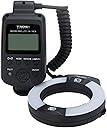
The YONGNUOYN-14EX TTL LED Macro Ring Flash Light for Canon is designed for photographers seeking to elevate their macro photography. With features like a large LCD display, high-speed recycling, and versatile compatibility with various lens filters, this flash light ensures you never miss a moment. Its automatic settings saving and sound prompt system make it a smart choice for both amateur and professional photographers.
| ASIN | B00F5UY9XE |
| Audio Recording | No |
| Battery Average Life | 1 Hours |
| Battery Life | 1 Hours |
| Best Sellers Rank | #33 in Macro & Ringlight Flashes |
| Brand | YONGNUO |
| Camera Flash | Macro |
| Color Temperature | 5600 Kelvin |
| Compatible Devices | Canon cameras supporting E-TTL / E-TTL II metering |
| Compatible Mountings | Canon |
| Connectivity Technology | PC Sync |
| Customer Reviews | 4.3 out of 5 stars 567 Reviews |
| Exposure Control Type | Manual, TTL |
| Flash Sync Speed | Variable (depends on camera model and settings) |
| Guide Number | 14 (to be confirmed) |
| Has Self-Timer | No |
| Item Dimensions D x W x H | 1.02"D x 4.84"W x 1"H |
| Item Weight | 499 Grams |
| Manufacturer | Yongnuo |
| Manufacturer Part Number | D907-LF6 |
| Model Name | Yongnuo YN-14EX |
| Model Number | Yongnuo YN14EX Canon |
| Mount Type | Hot Shoe Mount |
| Product Dimensions | 1.02"D x 4.84"W x 1"H |
| UPC | 739197567705 755357483142 519752203473 986057221073 520394689495 986057221080 519973000394 799637364059 799975143040 632930897261 110220404622 745780827835 808870052491 702411246458 |
| Water Resistance Level | Not Water Resistant |
| Wireless Technology | Optical Pulse |
D**N
For the price: Amazing
Update May 2019: Still going strong! I hike with my camera/camera bag frequently and this comes with me every time. I'm actually surprised that an inexpensive ring flash like this has held up so long and after a lot of rough treatment! I upgraded my camera since my original purchase to a Canon 80D and it works just as well with the 80D as it did with the 60D. Update April 2017: I've been using this ring flash fairly frequently over the last 2 years and thus far have not had a single issue. I use it mostly deep in the New Jersey Pine Barrens (forest) and often in very swampy areas on hot, humid days and still no problems at all. I will update this review again if I ever do have a problem. Original Review May 2015: I've been seriously into macro photography for about 8 years now and I put off buying a macro ring flash until now. I previously used a Canon 430EX flash and while it did an okay job it really isn't made for macro work. While I am a very serious macro photographer, having been published dozens of times in various textbooks, magazines and field guides, I am also an amateur, I don't make much money from my work and found it difficult to justify spending the cost of a Canon macro light. I've seen many off brand ring lights appear into the market for low prices but with comparable low reviews for lighting power and quality. I finally decided to take the chance with this one after seeing the great reviews and low price and I have to say that I am very glad that I did! The quality is exceptional and the functionality is equally impressive. I love being able to adjust the power of each side independently to create or eliminate various shadow effects. In just owning it a few weeks my work has improved greatly, I simply could never go back to a standard flash again for macro photography. The only negative for this flash, and really all macro ring flashes, is the ring shaped highlights it produces on subjects. If you really look at them they can be distracting, but to me, getting my subject well lit and in focus is the most important thing and for that, this flash really does the job. Camera: Canon 60D Lens: Canon 100mm macro Flash: Yongnuo YN-14EX
S**M
Amazing alternative to Canon's
My test bed: 5d mkiii / 7d mkii / 100mm is f2.8 A copy of the Canon MR-14EX, the Yongnuo YN-14EX is a great alternative for 1/5 the price. At the time of purchase I paid $100 for this, the Canon is $500. I'll try and hit all the main points here. eTTL: Works great. I have to use +1/3 flash EV using it on my 5d, and -1 2/3 EV on my 7d. The crop sensor (1.6x) of the 7d changes the effective focal length of the 100mm to 160mm. I believe this is what messes up the eTTL metering for that body. Thankfully this flash supports that EV compensation setting. Fit and Feel: I haven't used the Canon version, but this feels good. The 67mm ring adapter fit well. The ring flash is easy to attach or remove from the adapter ring. Body of the flash fits well on both my camera bodies' shoes. Whole unit feels pretty solid. Features: It has an assist light built into the ring. This is clutch, it makes catching focus in dark areas a breeze. You can also make the assist light only turn on when you half press the shutter. This supports FEB (Flash Exposure Bracketing), which enables the capability for HDR shots. You can ratio the strength of the left/right flashes. You'll notice if you look at the picture it has two elements. You can make the left 1/8 power, and the right 1 power, for example, or completely turn off the left one. This creates shadow effects, for artistic creativity. Be noted, this does not support HSS (High Speed Shutter Sync), this means you have to use the native sync number on your body. My 5d is 1/200, my 7d is 1/250. You couldn't use higher shutters like 1/500, 1/1000 ect..
S**N
Excellent Value!
I have been blown away with the quality of this ring light...its hard to imagine considering the much higher price for the Canon ring flash. Things I like: Build quality is great, nice solid feeling. Metal adapter rings that screw on to the front of the lens. Programmable LED pre-focusing/focus assist light. Easy to use menu. TTL!!! Easy and quick to adjust flash output when shooting in manual mode. Excellent results even when shooting in P-mode + TTL. It even has an external port plug for an add on battery pack if your shooting for long periods of time, or if you need to shoot high frame rates...the external battery pack will allow faster flash recycle times. Dislikes: Only one, and its the same for all screw on ring adapters...it would be nice if the lens cap could be put on, but in order to protect the lens, you'll have to remove the ring flash head and unscrew the metal ring adapter in order to put on the lens cap. -------------------------------------------------------------------------------------------------------------------------------------------------------------------- When I shoot macro's, its pretty much all day and I thought that it would be pretty heavy but that hasn't been the case. My system consists of a 7D w/battery grip, the 100mm L-is Canon macro lens, and the ring flash. Though altogether its a pretty heavy package, it all balances very well and last weekend I was shooting macro's for over 4 hours straight.
N**S
You won't be dissapointed
I'm not an avid macro shooter but on occasion I do have need for a ring flash. While I was initially skeptical, after all it's over $400 cheaper the Canon version, this flash turned out to be a gem. At full power in manual, the Guide Number for this flash is 25 (GN25). The only thing that I noticed is that I typically have to add between +3/4 and +1 flash power to get the correct exposure. Other than the need to add more output the TTL works like a charm. Oh Yea, the build is pretty solid. As far as the adapter rings go, they are the same as those used on Cokin Filter holders. I actually attached this to my Canon 70-200 f2.8/L using a cokin adapter and it worked great. If I didn't have to increase the output power to get the right exposure I'd give this 5 stars.
A**M
YN-14EX - Use the Savings to Buy a Macro Lens!
*** Cliffs Notes (for those with limited time, read this one paragraph then skip to the bottom!) This is an excellent unit for novice to semi-pro shooters. It has most of the settings you'd want in an extremely compact form-factor - ETTL, Full manual, A:B ratio settings for each side, etc. It's small, it's well built, bright, extremely consistent and fast. For those looking to test the waters without a huge investment, this is worth a look. It's also a great little unit for other uses, such as flash fill, or in use with multiple off camera flashes. I have several flashes including 2 Canon 600EX-RT's, and YN-E3-RT. The purpose of this flash was to have a compact, flexible and easy to use on-camera solution for macro photography. And now to the review! Personal Issues I have no problems laying out money for photography. If you've read any of my diatribes/reviews, you'll see I vacillate between bargain gear and the very best. By bargain gear I mean high quality, brilliantly designed and fabricated, competing with the best there is for less than exorbitant prices. Not just cheap - because there's lots of cheap photo gear. When I'm dipping my toe in new waters, these are especially enticing as I'm not sure I'm even going to use the product. If I do, I may very well buy something better once I outgrow it. These are the products I usually review - everybody already knows that the EF 24-70/2.8L lens is really, really good and really, really expensive. For instance, there has been some wonderful video related products coming out recently that IMHO are every bit as good as the big names, for a fraction of the price. This stuff gets me excited! Besides getting the word out on obscure and lesser known products, I hope to answer some of the questions I had about them myself. Macro Flash Ring Do you want or even need one? There are some advantages to the way it works, especially with macro photography. When shooting macro, you're often shooting at a very narrow aperture to keep your subject in relative focus. (we won't get into focus stacking software here!) If you're shooting say, a honey bee - even at f16 the entire bee might not be in focus. Additionally, at such a narrow aperture you're having to shoot at a much lower shutter speed to compensate. Even in bright light. Another consideration is distance. As you get close to your subject, literally placing the lens right up against it your own shadow becomes an issue. Unless it is being backlit by the sun or there are other light sources this can become an issue. Even if you move half an inch, you can instantly create shadows when recomposing. At close proximity, the light ring has the added advantage of being just as close as it can possibly be (the end of your lens!), while literally surrounding your subject with light. This isn't always possible using other types of flash setups as they're usually more distant. Also, these external flashes have the potential of being blocked by leaves and such. Using the Macro Ring Flash allows you to be much more flexible and creative in your shooting - usually with no forethought as to how you're going to get the shot. You just do it. If your lens can see it - it's getting light. After reading the review of the Canon MR-14EX II on The Digital Picture, I decided I really needed to try one out as part of my next step in macro. I've considered the Canon ring macro flashes in the past, but not for long! Macro photography isn't "what I do", but I like doing it, and it's certainly a tool that will help me improve. Of course buying a nice macro lens helped kick-start my desire! But with the Canon at $550, I felt as if I'd be just fine with a flash handicap for the foreseeable future! After all, what if I don't find it fun or even useful? That's a chunk of change. That's another 600EX-RT, or even a nice little prime. Then I thought about Yongnuo. Do they make one? I bet they do! They do! Once Bitten Twice Shy Yongnuo and I have a checkered past. While my early experiences with Yongnuo verged on near catastrophic and certainly embarrassing, I've recently given them a second chance. In the meantime I've invested in Canon 600EX-RT's, which will never embarrass me. I do a good enough job on my own, thank you very much. What brought me back for a second round with Yongnuo? It was the YN-E3-RT that tempted me not only because of the price, but it has features that Canon certainly should have on theirs. And the price. As I've had a fantastic experience with this product, I decided to give the YN-14EX a spin. The advantage of the Yongnuo over some of the other Chinese brands (some even cheaper) is that Yongnuo tends to make sure that their functionality is in step with Canon. Some of the other brands while quite good, are missing some of the features of this flash. At about $100 (price as of review) it can be viewed as either a stepping stone, a throw away or an investment. In the world of photography $100 is almost chump-change, and I'm a chu- er, cheapskate. If a product fails me, it might as well be $1k. I'll howl and moan along with the best drama queens. If the product performs to expectations or beyond, I'm disco dancing all night long and singing its praises. Out of the Box Normally the Yongnuo advantage is that they're virtual clones of the Canon product. There's no learning curve at all if you've used a similar Canon product. They function identically on the Camera menus as well. You can pretty much go out and start using it. Before the YN-E3-RT had a manual in English, I was using the Canon ST-E3-RT manual. I continued using it because it's better written! However, the YN-14EX IS different in this respect! While on first glance the back is very similar in layout to the MR-14EX II (missing only the focus lamp and ratio shortcut buttons), the 4 main buttons here in fact perform very different functions. It also differs from the first generation. So be prepared for a bit of learning, but not much. Because in fact, there's not much to learn. The only bells and whistles you'll find are the, uh, bells and whistles. It beeps, it buzzes, it ticks. Yongnuo's are nothing if not noisy! Yes, you can stop this. The settings are very rudimentary. You'll find no HSS here, no master/slave and no wireless flash control. What you do get is Manual and ETTL, exposure compensation, ratio settings for A:B, Rear curtain sync, modeling/assist light, FE lock, PC port and an external power supply port. About the only feature I would want from the Canon would be high speed sync - and at this price, I'll limp along. And seriously, HSS is something that's not going to get a lot of use in macro photography. For the simple reason that much of the time a user will be setting a higher aperture for focus depth, necessitating a slower shutter speed. While it's a feature I use frequently with flash photography in daylight - I really don't see needing a shutter speed faster than 1/250 frequently. If so, there are workarounds with manual settings. Opening the box you'll find a black zippered & padded carrying case. Inside you'll find the main control unit (body) which is connected to the flash unit via a sturdy non-detachable coiled cable. The flash unit consists of 2 C shaped flash tubes hidden behind opaque white diffusers. Unlike the new Canon, the diffuser exterior is not ribbed, nor does it appear there is any ribbing on the interior surface. There is a tube brace visible (using a flashlight) halfway along the interior of the reflector. Dividing the 2 C sections on each side are the 2 LED AF assist lights. These are elevated slightly above the surface. There is a raised section holding the cable on one side also indicating "up", with the branding and model description screened on. On each side centered over the tubes towards the back of the ring are 2 buttons to retract the retention clips. More on this later. The backside is bland, with a raised section to house the clip buttons, 6 set screws and indicators with little light icons which side is A and which side is B. This is actually kind of nice as it's a visual feedback when you're changing your ratios. Some of us still have L & R written on our hands. The control body is slightly less sexy - and looks like the bottom half of an old vivitar strobe for the most part. Surprisingly, even flashes like the Neewer are closer to the Canon in terms of appearance. On the lens side of the body, there is a raised section that would normally sport the transparent red window for the AF assist beam emitter. Here, it's just black nothing - sort of like they thought about placing something here. On the business end of the control unit, are 4 control buttons (similar in layout to the first generation Canon), a power switch, pilot switch and 4-way 4-button circle with center select button. On one side there's the battery door, which has a textured thumb spot, you simply press down and slide it - it then pops open. It feels relatively durable - and an improvement over earlier generations of Yongnuo flashes that had problems here. On the other side just above the locking wheel there are 2 rubber covered ports, one PC port and the other for an external power source. First complaint, the rubber "plug" for the power source is ill fitting and won't completely close. It is tethered however, which is good because if it weren't it would be long gone. My other Yongnuo products have no such issues with the rubber port covers. On that note, the build of the YN-14EX is not as nice as Yongnuo's Canon-competing flashes. The buttons are hard (most have the soft touch buttons and even back-lighting now), but the tactile feedback is nice. As on most Yongnuo's in place of Canon's select dial is their ubiquitous 4-way button. In a way, it's even less necessary as there's just not a lot of settings! Up/Down could be the same as Left/Right. But, the parts bin is the parts bin. Overall the fit and finish isn't quite as nice (the tolerances aren't as tight) as the best Yongnuo units - which go head-to-head with Canon. But the overall feel, weight and solidity of the Yongnuo is nice enough. It absolutely feels of a piece, and not like it's going to cause problems. I don't handle a 600EX-RT and then touch this thing and recoil in horror and disgust. They've chosen the places to cut corners well. The coiled cable is thick and well insulated, robust and attached on both ends with stiff flex fittings of the highest quality. A potential weak point has been nipped in the bud. The flash ring is suitably manufactured and braced, and if you take it and try to twist it, bend it, make it scream in pain - it's not going to give away the location of the enemy ships any time soon! Bottom line, all pieces are really solid and well done. There's no stray flashing, sharp edges or rough spots. For the price, it's still remarkable how they do it. Handling & Performance First things first. Unzip the carrying case in which your new toy is lovingly cocooned. Pull the flash and ring out of their individual padded compartments (yes, they're wired together). Open the sturdy battery door by pushing and sliding down, it will pop open. Drop in 4 AA batteries. I highly recommend if you're not using NiMH batteries, you start. They're not only superior in performance to regular lithium batteries in every respect, they'll save you a fortune after a while. Did somebody say close the battery door? It was a test. Next, slide the Yonguo control unit into the flash shoe of your camera, and turn the locking ring in the direction of the arrow that says "lock"! So far so good. Removing your lens cap and hood, you screw one of the 4 supplied adapters housed in an interior pocket of the case onto the filter threads (or filter) on your lens. 52mm, 58mm, 67mm and 72mm. Here I have to say the quality of these things really surprised me! Granted, it's a small thing - but they're immaculately finished smooth matte finish with the size screened on in white. The threads and machining are as good as I could expect from anyone. Canon used to give you a plastic piece of... Squirrel! Anyway, details like this make you feel as if you're using a professional piece of equipment - which you really are. *Note* I see a mention that Yongnuo also used to supply plastic piece of you-know-what adapters on older models. This is a commendable step up and one I'd even pay extra for honestly. Continuing, you've noticed with the supplied adapters you're covered for pretty much all macro lens sizes, as long as we're talking macro. We *are* talking macro, right? Yeah, me too. If there's anything resembling a de facto standard lens size, it would be 77mm right? What if you want to shoot this as a nice soft flash fill - since this thing acts like a beauty dish? And not use a Macro lens, but rather almost any other lens in your kit? The very first thing I did after ordering this was to buy a 77mm adapter on eBay. I figured if it was coming from China, it would take at least as long as the seller said it would (4-8 weeks), right? $5 (that's all - including shipping) and the thing was here in 7 days. 4 days after my prime delivery. Not bad. I feel better just having it in my bag. /rant. OK, we've finally got the correctly sized adapter on, right? Then, pushing down the 2 buttons on each side of the flash ring (retracting the 4 clips), place the flash ring over the filter ring, and release the buttons. The clips extend out behind the ring plate pulling the flash on even tighter creating a snug and positive fit. So snug in fact if you wish to rotate the ring, press the release buttons to do so. Otherwise you'll unscrew or tighten the adapter ring (or filter)! Now, press the power button and power it up! On the large LCD screen you'll see the little indicator-thermometer that tells you it's powering up or down. It will also give you a couple of chirps to tell you you've turned it on, and a longer tone to tell you that it's fully charged. The LCD screen has a nice, soft orange (yay!) illumination. You can control the time it stays lit, or press the lamp button to light it. Besides the basic displayed information on your settings, the screen will also show you: - battery life - overheat status (little thermometer) - A:B ratio settings (graphic of lamps left and right) - FEC, FEB, 2nd curtain, custom functions Everything considered, I was happy to see things like battery life and temperature status displayed. The menu and functionality is very straightforward. If you've used a flash or flashes, you probably won't even need to crack the manual er, pamphlet to figure it out. Save for the custom functions and sound/power settings I've not needed it. There's not a lot I can say about the quality of the flash itself, other than it's everything I could have hoped. Pretty much the first day I was using my new EF 100/2.8L IS for its intended use - I discovered the reason I need a flash like this. Of course an off camera flash of any type would help, but there's a noticeable advantage to having your light source just as close as possible to the end of the lens. Or in this case, being able to literally envelope the subject with a nice, soft, even illumination. But flat lighting isn't always flattering. As shadows are what gives your subject interest, being able to change the intensity of each ring half is important. I've found this to have the greatest advantage when the subject is a bit flatter - or when I'm shooting straight on. When I first got the flash, I thought that it landed somewhere in between the Canon MR-14EX and MR-14EX II as far as performance. It obviously took its cues from the new Canon, however there's a bit of the old design in there too as far as the button functionality and ring design. However now that I've used it it's obvious that the II was the target when designing it. From the very first shots I could see a huge difference in my comparison shots. One of the first things to strike me was that the light was far softer than I had imagined, and even better - it was not at all obvious. Just like those poorly directed action films - where the good guy is out in the desert all by himself wearing sunglasses and you can see the light reflectors and entire camera crew every time he turns his head - well that's half what I was expecting here. But even the honey bee's reflective qualities don't give away that it's not sunlight. I can also see the benefit for non-macro photography. The ring acts much like a mini beauty dish. I will certainly be experimenting further with this aspect of the Yongnuo. While it's not the most attractive thing you can have on your camera - it's powerful enough that you can almost consider it a mini softbox. It creates ideal on-camera on-axis lighting with none of the typical shadow cast you achieve with a typical single source strobe. The only downside I've found is that when acting as a catchlight the ring shape is not the most natural (or attractive) solution. I could see this as being an ideal solution for the budget minded if doing small product photography for say, eBay. The flash ratio for A:B moves in half-stop increments from 8:1 to 1:1 to 1:8, with the equivalence of 3:1 through 1:3 in f stops. This is plenty to move between the two groups and identical to the Canon's functionality. Exposure compensation in both manual and ETTL has a range of ±3 in 1/3 stop increments. What we don't have is the ability to set additional slaves as group C in wireless or otherwise. At first this seems like a huge omission, but honestly for my purposes this acts as a stand-alone unit. If you have grander schemes - then you might want to take a pass. A couple of features that did make it on the Yongnuo is flash exposure bracketing (1/3 EV at ±3), so it will work seamlessly with your Canon when bracketing. Again - I'm not sure I'll find myself bracketing with macro work - but who knows! Also present is 2nd curtain sync and flash exposure lock. The latter will fire the pre-flash, and then store the data until you pull the trigger. The display stays up for half a second, but I would assume there's no time limit to the actual flash lock. This latter feature is certainly one that will get used - I'm pretty old school when it comes to focus/exposure lock and recompose. Also the press of a button can illuminate one or both of the LED AF assist lights to use as modeling lights. I haven't really found a reason or purpose to use this for just yet. Pros - Fantastic price - Excellent physical build - 4 aluminum adapter rings (not just 1) beautiful finish and highest tolerances: 52, 58, 67 and 72mm - Amazing & consistent performance - Very fast recycling times - Powerful - Soft even illumination - Color consistency - Proper flash tubes & not LED - Dual LED AF Assist/Modeling light - Variable A:B group settings - ETTL, FEL, FEC and 2nd curtain - Included: padded carrying case with fixed padded compartments Cons - No HSS - No wireless functions - No slave mode - No 77mm adapter! - Locking wheel, not lever - Not weather resistant - Physical build on Yongnuo's low end - Control unit appearance & layout rather primitive compared to competition - External power supply cover ill-fitting on my copy Summary This is one excellent product from Yongnuo. They've balanced the features and performance with the price point and created an absolute winner. Omissions of features such as HSS and wireless first appear to be glaring issues, but on reflection I'm not sure if either of those would ever see use for my purposes. The main reason I purchased this was to act as a compact standalone unit. I can't say where or how I'd ever implement wireless with a secondary flash. While the absence of HSS is something I never see as being an issue as long as this is used for its primary purpose as a portable single unit and macro work. Aside from macro work, HSS requires more power to do right than this little unit is capable of anyway. That's when the 600EX-RT's come out - and when wireless comes into play. At this point I don't know why I would want to spend an extra $450 on the Canon. I have no doubt the MR-14EX is as excellent as everything else they make. Like my 2 600EX-RT's. For a lot of people the Canon is absolutely the right choice. However, for a lot of people the YN-14EX is absolutely the right choice by a wide margin. If you too are dipping your toe into new waters, or are just starting to consider kit for macro photography - do yourself a favor and consider this great little flash. With the money you'll save you could get the Tamron 60mm macro and have enough left over for a protective filter or a camera case. The overall performance is 4 stars, the feature set is 3 stars, but the price adds one more star again, and the overall build quality a half star. On the Amazon touchy-feely review scale, it rates 5 "I love it" stars easy. Right now I'm giving it a big 5, rating systems aside. It's not often I'm happier than I ever thought I'd be with a product. Either I underestimated my needs, or Yongnuo exceeded my expectations. Perhaps it's both of those. If you've ever considered such a tool, you'll be glad you tried it out. At this price and with Amazon's return policy you've got nothing to lose. Thanks for reading.
S**E
Works with my Sony a6000 (and also with my friend's Sony NEX6)
I bought this for my Sony a6000, not knowing if it will work correctly. I am so happy that the flash works now. Even the E-TTL works on my Sony a6000. But I had to get it to work with my Sony a6000 due to reasons that were not a fault of this Flash. Because this flash worked fine on my friend's Sony NEX6 out of the box. I got it to work with Sony a6000. However, please note that you may need to buy a hotshoe converter. Let me explain this. This flash has a Canon hotshoe which is compatible with the Sony NEX/a6000 camera hotshoe but on the a6000 it may need some extra work to get it to work. There are two types of a6000 - Black and Silver. I have the black one and the hotshoe is painted black. The flash didn't work on my a6000 at first and a lot of people online suggested scraping off the black paint on the hotshoe. So I did that and then the flash *kinda* worked only if I pushed it against the camera body (I guess because it was loosely fit as there was some wiggle). On my friend's Sony NEX6 which has the same hotshoe (but not painted black), the flash worked with 100% success. So then, I bought this canon to sony hotshoe converter that makes this flash work perfectly with my a6000 with no need to push it against the camera body and also you won't need to remove any black paint from the hotshoe if you use this converter. No complaints since then. To find this converter search Amazon for: "Neewer Black Flash Hot Shoe Converter Adapter for Sony Cameras Camcorders A7 A7R A7II A7S A6000 NEX-6 A99 A58 RX1 RX1R RX10 RX100M VG900E VG30E CX900E" or this link: https://www.amazon.com/gp/product/B00R7H481G/ref=oh_aui_detailpage_o00_s00?ie=UTF8&psc=1 All the functions on this flash work on my Sony a6000. I have added some photos. Please note that I have also added an extension bar to my camera so that I remove the weight of the flash's control box from the camera's hotshoe. The control unit (the one with the LCD and buttons) gets very heavy when you add 4 AA batteries in it. If you attach it to a mirroeless camera, it takes the weight with no worries but I just don't want to wear off the hotshoe on my camera very quickly due to this added weight so I added an extension bar which holds the weight of the control unit of the flash. Please see the pictures. Thanks a lot Hopefully this will save
M**M
This is a great ring flash-but be careful about the door!
This is a great ring flash, the build quality is good, works great, offers variety of lighting options, really made a difference in my macro shots. used it to photograph rocky shore species (barnacles, limpets, crabs, anemones, etc.) and I can see the difference between the shots before and after I have started using this. I have a few disappointments with the build/design of this flash though that I have listed below in cons, which is why I gave 4 stars. Pros: various power settings makes it easy to shoot macros in different focus distance and lighting conditions. The two lights on either side and the ability to turn off one makes it really easy to light macros when there is natural light coming from one side. The build quality is good, with well built cable attachment and secures well on hot shoe. Cons: Battery door is asking to break off, you really really need to be careful opening/closing the door, the batteries fully push the door off while you try to close the door. This is a poor design and could be easily fixed if the manufacturer had used a mechanism to secure the batteries to the body before the door is closed rather than using the door to secure the batteries. The ring mounts on lens using filter thread: there are two critically important flaws in this design: 1. once you mount the flash metal ring you cant close lens cap. Every time you need to unscrew the metal mount from the filter thread and screw it back again (not easy as you have to align it really exactly to be able to screw it). It could be much easier if the flash could be mounted using some type of push mechanism with soft/elastic ends that holds on the lens head. 2. You can only mount the flash on lenses that the ring has the metal ring available (52mm, 58mm, 67mm, 72mm), so for example if you use an extension mounted Canon 50mm f/1.8 lens (which has 49mm filter thread) for macro use, you wont be able to use this flash (unless you use a filter adaptor). Summary This is a good quality flash with affordable price, but has a few design drawbacks which could be easily fixed. I like it and I am happy I bought it, which is why I gave 4 stars, but I also thought to include constructive critics that could potentially help the design to be improved if the manufacturer takes feedback from the customers. UPDATE: Ok, after less than 2 months that I had bought this flash, what I was expecting happened last week: all of a sudden for no reason I noticed the battery door is open while I was shooting macros, tried to close it but realized it does not stay closed, checked then realized that the little plastic nub that was holding the door is broken and fell off while I was inspecting.. There had been no shock to the flash or anything, this just came off! I suppose the pressure from the batteries just breaks the door after a while. What a poor design for otherwise an excellent flash!! So long story short, I wasn't going to throw it away as I am not making money from photography and I have a decent hand in DIY, so I got to work with my limited tools in my apartment. After pondering how I can hold the door in place, I came up with a plan to screw the end of the door to the body (result in 1st image). Before making the screw hole I had to make sure that there is no electronics behind the plastic inside the body, so I had to open the 4 screws that hold the base of the flash to the body (2nd image). Then looked inside and made sure that there is no wires or electronics on that area. I used my iron soldering gun to make a hole in the side of the battery door then screwed a screw in it while the plastic was soft. Next, I was going to make a hole in the door, but I realized that the door has two layers, one plastic which is on top, and there is a metal layer which sits on the batteries and clips to the plastic top cover. After trial and error, I worked out how to take the plastic cover off the metal layer (there are holding nubs in the metal layer that I had to break them off to make separating the plastic cover easier next time). The metal layer was covering the screw hole that I had just made, so I had to break off the edge of the metal cover by pliers (not easy, the metal layer is decently thick, but I made it at the end). Once I removed enough of the edge, the screw could go through the plastic hole and, once tight, held the metal cover tightly while the batteries in place. Now the challenge was to put back the plastic cover. I figured out there are small nubs on the plastic door that hold on the metal cover, sliding on it. However, the challenge was that the plastic door had to be placed before the metal cover was secured in place by my DIY screw, which wasn't practical with my DIY adjustment as I had to tighten the metal cover while the plastic cover was off. So I had to adjust the plastic holding rails of the plastic door by screw driver so the plastic door slides to the metal while the metal is already screwed in place (sounds complex but really easy). With this adjustment in the plastic door, once the metal cover is secured (as in image 1), I can easily slide the plastic cover in place and the flash looks as original! Now if Youghoo had done its job properly I didn't have to go through this with my primitive tools, but what I can do. And I didn't take any stars off for the hassle that I went through, the original 4 stars are still shining. Update Jan 2018: I have used this flash occasionally since last update as above, one major issue that I haven't mentioned above is this flash drains the battery very quickly, one set of 4 AA batteries barely last 30 shots. Another major issue is that it doesn't work on my Canon 6D mk 2, very disappointed as I needed this to work on my 6D2. The Canon version is ridiculously expensive so I've been looking for an alternative, cant sell this one to save the money to buy another one as the battery door is modified after it broke as explained above. Essentially my 100 USD plus shipping lost without getting much use out of this.
N**K
The flash to get when getting into Macro.
I've now purchased two of these flash units. The 1st for myself, the 2nd for my girlfriend who also has an interest in Macro Photography. Thanks to E-TTL using this flash is EASY! I've never felt the need to take it out of ETTL mode and I've shot this using my 70D, 6D, and her T5i. The most I've needed to do was adjust the flash compensation on the camera itself or on the flash unit which is also a simple process. For $102 this is, in my opinion, the best flash ring you'll find without spending 2x - 3x more on a Canon or Nikon unit. The trade off for the price is loss of HSS (High Speed Sync), which will limit you to your Camera's max HSS (1/250 for 70D and T5i, 1/180 for 6D). The build quality feels great, the buttons on the back are easy to press and the screen is easy to read (If you choose to use the flash in manual mode). One very very very minor complaint I have is the threads on the step-up rings don't feel high quality. This caused me to pickup a Hoya filter for my 100mm Canon so if there were any issues caused by the threads it would happen to a filter, and not my $1k lens. Helpful Tip using this: With ETTL you'll notice pretty quickly your subject will be exposed properly but you may have a black background. To help with this boost your ISO to 400-800. In ETTL the flash automatically compensates for the new exposure and your subject doesn't appear to be in front of a black studio screen.
M**L
Macro photography ring flash
Excellent product. As described and arrived on time. Very satisfied with this flash.
S**P
Works well with Nikon camera
The flash came rather fast and works well with Nikon cameras. It is surprisingly easy to use and hopefully it lasts.
R**S
Buena relacion calidad precio
Es de gran ayuda para la sfotos, yo tomo intraorales y me ha servido mucho, no he tenido fallas, viene con los adaptadores para los diferentes lentes
P**H
Good product.
Its a very good product for macro and portrait photography. I will recommend it to every beginner and professional photographers. It comes with four mount rings for canon, which can be used with all lenses by using step-down or step-up converters. It fits perfectly and is quite stable with STM lens movement, but USM lens focus movement need to be considered. It looks very professional.
W**M
Tudo certo
Chegou bem embalado e rápido
Trustpilot
3 weeks ago
4 days ago