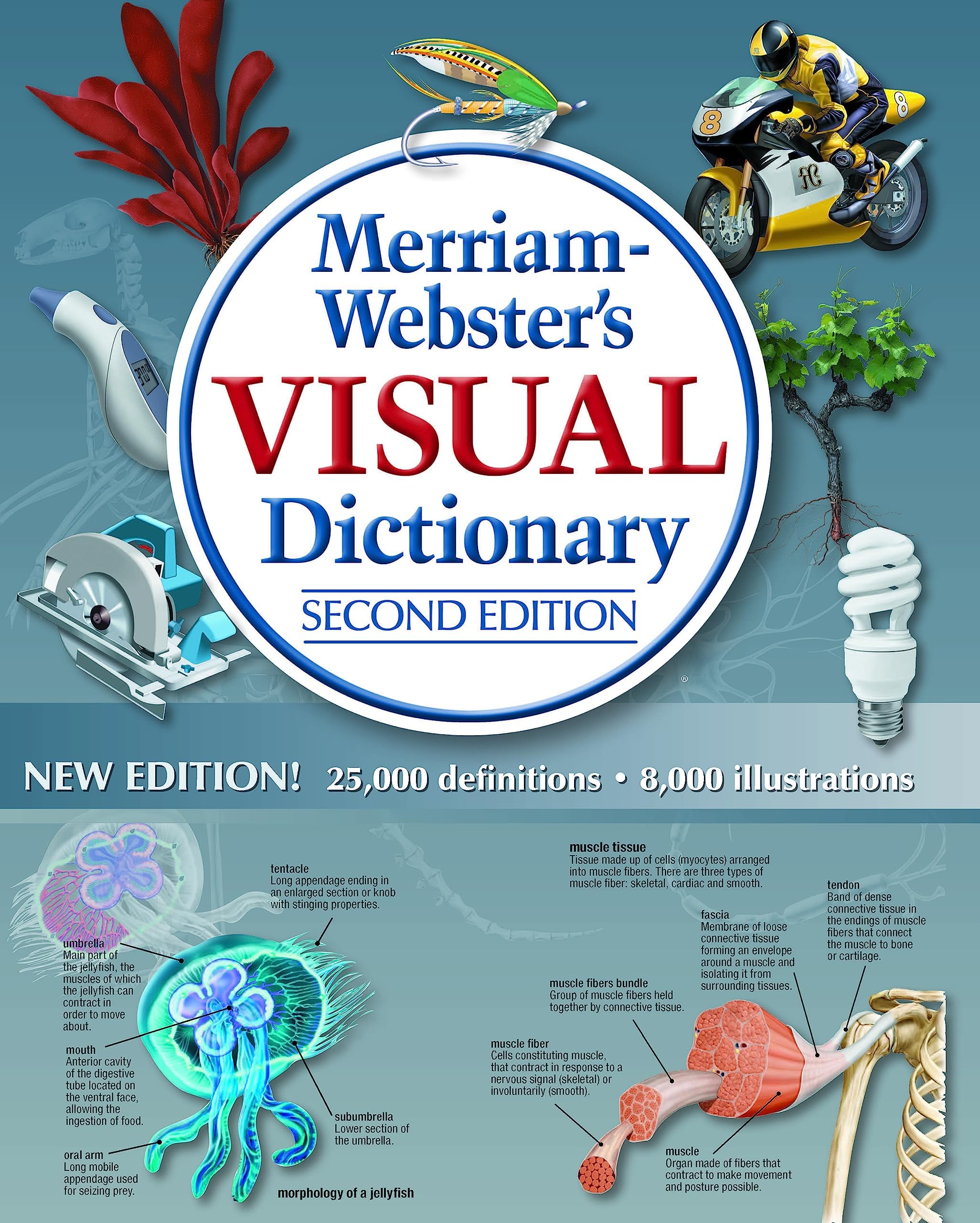
Merriam-Webster’s Visual Dictionary: Second Edition - Newest Edition: Second Edition
Product ID: 4572130
Desertcart purchases this item on your behalf and handles shipping, customs, and support to UAE.
Enrich the mind and discover something new with each turn of the page in this delightful book for visual learners, curious kids, or students new to English! This beautifully illustrated visual dictionary incorporates nearly 25,000 terms and their definitions into 8,000 full-color illustrations of a wide variety of objects from all aspects of life. 2,000 new and updated illustrations, including many from the fields of technology, medical equipment, and energy Clear, concise definitions from the word experts at Merriam-Webster Eighteen chapters and 115 corresponding themes include a wide variety of fields including astronomy, the earth, human beings, the animal kingdom, plants and gardening, house and do-it-yourself, food, arts and architecture, clothing, science and energy, sports and games, and much more The perfect book for work, school, self-study, research, or simple browsing. Review: Engaging, illustrated dictionary, describing how things work - This is a great dictionary, especially for you with children. However, adults find it very interesting as well. It has beautiful illustrations showing how things work along with the illustrations are wonderful and understandable explanations. I strongly recommend it. Review: The World of Things - What is it, daddy? What is it for, mommy? These two primary questions, or some semblance of these questions have probably been asked millions of times by millions of children about millions of things in our world, and form an ever-expanding nexus of knowledge, ideas, and associations that fans out well into adulthood. Adults still ask these same basic questions that they did as children about the identity of things and the function of things around them, albeit in a more sophisticated, complex fashion perhaps, but the goal is essentially the same--to better understand the visual world of the thousands and thousands of things that surround them. We seem to never tire of asking those fundamental questions of what something is and what something does. This superb, highly-organized, detailed reference book brings the best of two worlds together--the visual, concrete, pictorial world of the sights, colors, shapes, and images that inhabit our physical world, and the more abstract world of words and language that shape and define our mental world that houses our thoughts and ideas. The text, explanations, definitions, and descriptions in conjunction with the pictures, drawings, diagrams, and illustrations create an interesting and informative learning tool that enriches and enlivens the world of things.


| Best Sellers Rank | #12,811 in Books ( See Top 100 in Books ) #8 in Dictionaries (Books) #12 in Children's Dictionaries (Books) |
| Customer Reviews | 4.8 out of 5 stars 645 Reviews |
T**R
Engaging, illustrated dictionary, describing how things work
This is a great dictionary, especially for you with children. However, adults find it very interesting as well. It has beautiful illustrations showing how things work along with the illustrations are wonderful and understandable explanations. I strongly recommend it.
D**D
The World of Things
What is it, daddy? What is it for, mommy? These two primary questions, or some semblance of these questions have probably been asked millions of times by millions of children about millions of things in our world, and form an ever-expanding nexus of knowledge, ideas, and associations that fans out well into adulthood. Adults still ask these same basic questions that they did as children about the identity of things and the function of things around them, albeit in a more sophisticated, complex fashion perhaps, but the goal is essentially the same--to better understand the visual world of the thousands and thousands of things that surround them. We seem to never tire of asking those fundamental questions of what something is and what something does. This superb, highly-organized, detailed reference book brings the best of two worlds together--the visual, concrete, pictorial world of the sights, colors, shapes, and images that inhabit our physical world, and the more abstract world of words and language that shape and define our mental world that houses our thoughts and ideas. The text, explanations, definitions, and descriptions in conjunction with the pictures, drawings, diagrams, and illustrations create an interesting and informative learning tool that enriches and enlivens the world of things.
A**R
Impressive book to help a student learn visually.
This is a great book. Its BIG. I bought this to help with my Read to Learn Students who are trying to improve their English. One of my students originally from Siberia, loves the pictures and how you can relate to the picture and the words in English. He is studying nerves, muscles and ligaments and a whole section of this book is devoted to the human body. The book is impressive.
T**S
Loving this
My son is in the spelling bee and we were looking for different ways for him to retain spelling and defintitions and the visuals from this is great for our aims.
R**D
Good Quality
Great Quality, I'm really happy with it.
O**E
A bit more text could have made the book much more enjoyable!
A bit more text could have made the book much more enjoyable! Although the picture are wonderful, discussions with the kids at home tend to be richer when there's some short but enlightening text next to the pictures. Still, at this price, the book remains a good investment.
B**S
I read when needed.
Reading and Learning book.
S**A
Bravo, Merriam-Webster
The delightful cure to “What’s it called?”
買**マ
英語を楽しく学ぶ工夫を 美術が得意な人なら当商品のような英語圏の図鑑を活用して英語を学ぶ工夫が可能です活用して英語を
英語圏の子供達や学生さんが使う図鑑的な書籍です。 イラストから何について解説しているか予測しながら見慣れない英文を感覚で理解出来るようになる訓練になります。和訳せず英語を英語のまま理解出来るようになるためにはスポーツと同じように練習(特訓)して継続していくうちにひらめいた時のように感覚で理解出来るようになってきた実感を体験できます。 English This is an illustrated book used by children and students in English-speaking countries. It trains you to intuitively understand unfamiliar English sentences by predicting what is being explained from the illustrations. To be able to understand English as it is without translating it into Japanese, you need to practice (train) like in sports, and by continuing, you will experience the feeling of being able to understand intuitively, just like when you have an idea.
C**N
vade mecum
great source, a must-have...
C**N
FONDAMENTALE
Libro bellissimo e foto stupende, per i cultori dell’inglese un must. Unica nota, questo editore tratta solo inglese americano, NO britannico
M**K
Good book publishing
Good quality makes me fully satisfied..good and enrich paper quality.Awesome !
S**S
Ausgezeichnet, wie alles von Merriam-Webster's
Ein paar lose Informationen: 1. Das Wörterbuch ist extrem umfangreich. Ich hatte überlegt zwischen dem Merriam-Webster's Visual Dictionary und dem von DK, das einen ausgezeichneten Ruf genießt und anscheinend sehr viel bekannter als das von Merriam-Webster's ist. Ich habe mich dann aber doch für Merriam-Webster's entschieden, weil dieses nur 50% teurer als das von DK ist, aber wesentlich umfangreicher. Also es ist wirklich sehr umfangreich. Man findet so ziemlich alles, was man sehen oder anfassen kann, hier drin. Weinkühlschrank? Alle möglichen Arten von Kaffeekochern? Ja, wirklich alles. Eine Ausnahme: Ich habe bei der Katze nicht gefunden, wie die Pfoten heißen. Vielleicht war ich nur zu blöd, danach zu sehen. Beim Hund ist es beschriftet (zwei Seiten davor). Ansonsten ist so ziemlich alles mehrmals beschriftet, wenn es auf mehreren Bildern zu sehen ist, zum Beispiel das Dachfenster sowohl beim Haus als auch beim Zimmer. 3. Das Wörterbuch ist extrem schwer. Unter Umständen ist es doch sinnvoll, die Compact Edition zu kaufen. Ich werde meins behalten, aber ich würde beim nächsten Mal doch compact vorziehen. ;) 4. Es ist ein Wörterbuch, kein Lexikon. Eine andere Rezension behauptete das Gegenteil, ich will unbedingt diese Einschätzung loswerden. 5. Dieses Wörterbuch beinhaltet ausschließlich amerikanisches Englisch. Alle Wörterbücher von Merriam-Webster's sind auf amerikanisches Englisch ausgerichtet. Die meisten potentiellen Käufer werden das vermutlich wissen, aber einige vielleicht nicht. 6. Es ist keine Lautschrift vorhanden. Für mich kein Grund, einen Stern abzuziehen, aber mit Lautschrift wäre es tatsächlich besser. Das DK-Wörterbuch enthält allerdings auch keine. 7. Wozu braucht man ein visuelles Wörterbuch? Zu meiner Situation: Ich bin dabei, mich auf meine IELTS-Prüfung vorzubereiten. Beim Vorbereiten vor allem auf den Sprechteil mit der IELTS Speaking Assistant App (empfehlenswert!) ist mir klar geworden, dass die größte Schwachstelle bei meinem Englisch ist, dass ich noch viele Dinge "um mich herum" nicht benennen kann und sie umschreiben müsste, was sich jedenfalls nicht positiv auf den 'Speaking Band' auswirkt. Wäre ich auf die Aufgabe, zwei Minuten lang über ein Möbelstück zu sprechen, nicht vorbereitet, würde mir diese zum Verhängnis werden. Das war für mich der Hauptausschlagspunkt, ein visuelles Wörterbuch zu kaufen, obwohl ich schon vorher mit dem Gedanken gespielt hatte. Denn ansonsten ist mein Vokabular recht gut. Sein Vokabular kann man auf unterschiedliche Weise erweitern: Sehr hervorragend fand ich 1100 Words You Need To Know von Barron's, daneben gibt es diverse andere Angebote wie den Merriam Webster's Vocabulary Builder (der mich aber nicht so sehr überzeugt hat), Word Power Made Easy von Norman Lewis, oder z.B. die Oxford Word Skills-Reihe und vergleichbare Bücher. Dazu gehört ein anständiges Synonymwörterbuch wie das Merriam-Webster's Dictionary of Synonyms and Antonyms in das Bücherregal ein es jeden, der ernsthaft gutes Englisch lernen will. Was diese Bücher gemeinsam haben, ist: Sie behandeln im Wesentlichen Adjektive, Verben und "abstrakte" Substantive (daneben ist natürlich noch die richtige Verwendung von Präpositionen usw. wichtig, aber auch das kann man gut lernen zum Beispiel mit Collocations in Use von Cambridge und diversen 'Collocations Dictionaries', teilweise kostenlos als App mit Werbung erhältlich). "Dinge zum Anfassen" kommen überall darin nicht vor, sind aber natürlich ebenso wichtig bzw. eigentlich wichtiger, und dafür bietet ein visuelles Wörterbuch eine ganz hervorragend geeignete Ergänzung. Beispiel: Wie heißt das Ding eines Wasserkochers, wo das Wasser herauskommt? Mittlerweile weiß ich, dass das ein "Ausguss" oder "Schnabel" ist. "Ausguss" war auch meine Vermutung. Hätte ich jetzt nur ein konventionelles Wörterbuch, würde ich also "Ausguss" mutmaßen, im Wörterbuch danach suchen, und "spout" erhalten und damit im Unklaren bleiben, ob es tatsächlich dieses Teil des Wasserkochers ist, das ist beschreiben wollte, oder ob es nicht etwas ganz Anderes ist weil "Ausguss" etwas völlig Anderes ist. In diesem Fall würde ich, um sicherzugehen, in einem monolingualen Wörterbuch wie dem Merriam-Webster's Collegiate nach "spout" suchen und die Definition erhalten: "spout, noun, 1: a pipe or conductor through which a liquid is discharged or conveyed in a stream [...]" Mit einem visuellen Wörterbuch suche ich einfach einen Wasserkocher und bekomme die passende Stelle als "spout" beschriftet, inkl. Definition. Dazu kann ich auch gleich alle anderen Teile des Wasserkochers lernen. Ganz in der Nähe, möglicherweise sogar auf derselben Seite, finde ich alle anderen Dinge, die in der Nähe meines Wasserkochers stehen.
Trustpilot
1 month ago
1 day ago