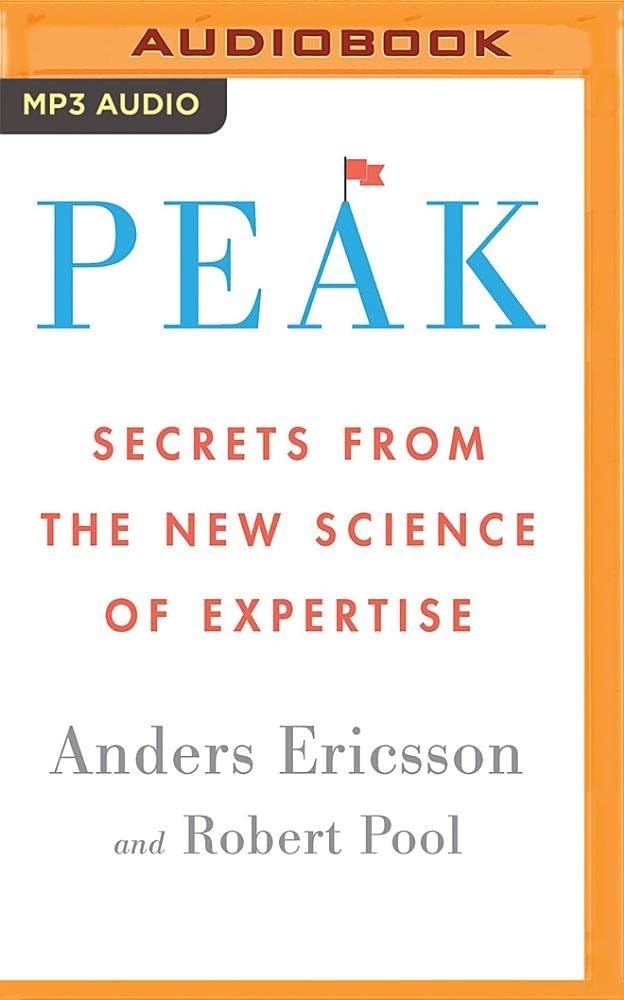
Peak
Product ID: 76338036
From the world's reigning expert on expertise comes a powerful new approach to mastering almost any skill. Have you ever wanted to learn a language or pick up an instrument, only to become too daunted by the task at hand? Expert performance guru Anders Ericsson has made a career of studying chess champions, violin virtuosos, star athletes, and memory mavens. Peak condenses three decades of original research to introduce an incredibly powerful approach to learning that is fundamentally different from the way people traditionally think about acquiring a skill. Ericsson's findings have been lauded and debated but never properly explained. So the idea of expertise still intimidates us - we believe we need innate talent to excel or think excelling seems prohibitively difficult. Peak belies both of these notions, proving that almost all of us have the seeds of excellence within us - it's just a question of nurturing them by reducing expertise to a discrete series of attainable practices. Peak offers invaluable, often counterintuitive advice on setting goals, getting feedback, identifying patterns, and motivating yourself. Whether you want to stand out at work or help your kid achieve academic goals, Ericsson's revolutionary methods will show you how to master nearly anything. Review: Insightful Book on Skill and Improvement, with a Few Slow Spots - Peak: Secrets from the New Science of Expertise was a really solid read and gave me a new perspective on how people actually develop high-level skill. One of the biggest takeaways for me was how much improvement comes from deliberate practice rather than natural talent. The book explains this in a way that’s easy to understand, with plenty of real-world examples that keep you thinking about how you can apply the ideas to your own life. The strengths: The authors do a great job breaking down the science behind expertise without making it feel overly academic. A lot of the concepts are motivating — showing that with the right kind of practice, most people can improve far more than they think. I also liked the chapters that explained how to push yourself past plateaus, which felt practical and actionable instead of just theory. The drawbacks: There are parts of the book that feel a bit repetitive, especially when they revisit the same idea from different angles. Some examples are interesting but run a little long, and if you already know the basics of deliberate practice, certain chapters may not feel as new or surprising. Also, the book focuses more on the big-picture concepts than detailed step-by-step plans, so readers looking for a strict “do this daily” guide might want a little more structure. Overall, it’s a very good book with plenty of insight into how experts develop their skills — definitely worth reading if you want to improve at something or understand how top performers are made. The message is motivating and backed by solid research, even if a few sections take their time getting to the point. Review: To make real progress, working harder/working smarter aren't enough. But this book tells what is... - I hesitated to buy this book, because I have read so much about Anders Ericsson's work already, and have used what I (thought I) knew about it in my own life, and in my work as a business coach in the very specialized field of direct marketing copywriting. Wow... and this is not the copywriter in me, this is the student, teacher, and coach speaking from here on in... wow, am I glad I got past the hesitation and bought it. I haven't finished reading it yet. I'm at about page 175 of 300. But what I've read so far has opened my eyes, shaken up my brain, put new courage in my heart, and motivated me in ways that are more experiential than describable. It's kind of weird, because I'm reading the book from three points of view, almost at the same time: 1) As a coach, who helps others reach their personal peaks (and often, raise the limit on what they thought their own peak was) 2) As someone who has been very successful at a few things and not so successful at all at a number of other things, and 3) As a beginner, a student, who at age 63, has started on a rather challenging journey and is eager for all the help and insights he can get. I've reflected on my own life, and the successes of my most accomplished coaching clients. In the light of what I've read in the book so far, I realize that a lot of big wins came either from purposeful or totally accidental deliberate practice. I thought I knew what it was, but this book fills in what either I didn't know, or was mistaken about, with great clarity and care. Deliberate practice, of course, is self-imposed focused work on raising your skill level where doing so will bring you the greatest gain. It's more than that, though. The authors politely hint about it, but I'll say it blatantly: Deliberate practice, when done right, can take you to a place of confusion and personal terror the likes of which you might never imagine, if you haven't experienced it before. Not forever. But for at least a little while. Not always. But it can happen. I've experienced this myself, and spoken quietly with clients of mine who were also Olympic medal winners and other world-class performers. High anxiety... happens. Sometimes. Here's why: You're rewiring your brain. Literally. You are creating new neural pathways, rearranging the organization and use of your brain cells, and in some cases, actually enlarging portions of your brain (an example you may be familiar with if you've read any of Ericsson's previous work is the fact that the two hippocampi, the seahorse-shaped lobes in the brain, actually got larger in the heads of London cabdrivers, as a result of the ridiculously detailed amount of memorizing they had to do to get, do, and keep their jobs). OK. So rewiring your brain -- sounds like an exciting adventure, right? Well... partially. But you also can get disoriented. Anxious. Even very scared. Because suddenly the familiar world you were living in, is different. And as exciting as that may be (especially... eventually), it's also disturbing at times. When the great champs say, "No pain, no gain," it's not just physical muscle aches and fatigue they're talking about. There are mental and emotional aspects to growth in skill and capability, too. I can't recall seeing as detailed a description, and explanation, of what happens and why, as I have in this book. Ericsson and his co-author clearly took a lot of pains themselves to bring the science of deliberate practice to a new level of clarity and accessibility. So I don't want to dwell on my own past glories or those of my clients. If for no other reason, because what's most fascinating to me about this book was how it helped me get clear on what I'm going through with the new thing I'm working on, and understand at least in general terms, what's ahead. By the way, "10,000 hours" was either very clever promotion or insufficient research on Malcolm Gladwell's part. While it turns out that most professional violinists and most professional dancers have put in roughly that much time to achieve mastery, Ericsson definitively says (and proves) that the number varies depending on the person and what they are applying deliberate practice to. (It can be less. It depends on a lot of things.) Which... is a relief to me. Since, at 63, if I were to put 10,000 hours going forward into what I'm doing, and I could do it 24 hours a day, seven days a week, it would take me over a year. But at a more reasonable rate of two hours a day, every day, it would take me over 13 years. Hey... that's too long! What is this labor of love I'm looking to become skilled at? Playing guitar. I started when I was nine, and stopped sometime in my teens. Then, something came over me a year ago, and I picked it up again. I finally settled into a routine about six weeks ago. Now I didn't get a roadmap or a timeline from this book as to how long it will take me to get how good. Nor would I expect to. But what I did get, which is so valuable to me in so many ways, is the clearest possible definition of what deliberate practice is, and how so much of the world of training, teaching, and coaching (including -- ouch! -- guitar instruction) just doesn't get it. Plus, the book gave me a very clear idea of what to look for, what to steer clear of, and what I can do for myself. The key takeaway is this: Deliberate practice isn't fun. But it's necessary. It's not the only practice you need or want to do, whether it's playing guitar, or any other skill you are seeking to develop. In fact, you probably shouldn't do deliberate practice on anything for more than an hour at a time -- and that's Ericsson's advice, not mine. But deliberate practice IS pretty much the only way you can make massive and lasting improvements -- and, as long as you have reasonable health and a functioning brain, it's available to you. Even if you're a "senior citizen," like me. :) That's why I like this book so much. I've never seen information about advancing skills... whether a little, or to a world-class level, or anywhere in-between... laid out so clearly and comprehensively (and convincingly) as it is here. If you are looking for "the missing piece" in achievement, you very well might find it in this book. For me at this time in my life -- I did. Thanks, Anders Ericsson and your co-author, Robert Pool.
| Best Sellers Rank | #4,042,336 in Books ( See Top 100 in Books ) #38 in Job Hunting & Career Guides #223 in Personal Transformation Self-Help #22,345 in Books on CD |
| Customer Reviews | 4.6 out of 5 stars 3,624 Reviews |
S**M
Insightful Book on Skill and Improvement, with a Few Slow Spots
Peak: Secrets from the New Science of Expertise was a really solid read and gave me a new perspective on how people actually develop high-level skill. One of the biggest takeaways for me was how much improvement comes from deliberate practice rather than natural talent. The book explains this in a way that’s easy to understand, with plenty of real-world examples that keep you thinking about how you can apply the ideas to your own life. The strengths: The authors do a great job breaking down the science behind expertise without making it feel overly academic. A lot of the concepts are motivating — showing that with the right kind of practice, most people can improve far more than they think. I also liked the chapters that explained how to push yourself past plateaus, which felt practical and actionable instead of just theory. The drawbacks: There are parts of the book that feel a bit repetitive, especially when they revisit the same idea from different angles. Some examples are interesting but run a little long, and if you already know the basics of deliberate practice, certain chapters may not feel as new or surprising. Also, the book focuses more on the big-picture concepts than detailed step-by-step plans, so readers looking for a strict “do this daily” guide might want a little more structure. Overall, it’s a very good book with plenty of insight into how experts develop their skills — definitely worth reading if you want to improve at something or understand how top performers are made. The message is motivating and backed by solid research, even if a few sections take their time getting to the point.
D**L
To make real progress, working harder/working smarter aren't enough. But this book tells what is...
I hesitated to buy this book, because I have read so much about Anders Ericsson's work already, and have used what I (thought I) knew about it in my own life, and in my work as a business coach in the very specialized field of direct marketing copywriting. Wow... and this is not the copywriter in me, this is the student, teacher, and coach speaking from here on in... wow, am I glad I got past the hesitation and bought it. I haven't finished reading it yet. I'm at about page 175 of 300. But what I've read so far has opened my eyes, shaken up my brain, put new courage in my heart, and motivated me in ways that are more experiential than describable. It's kind of weird, because I'm reading the book from three points of view, almost at the same time: 1) As a coach, who helps others reach their personal peaks (and often, raise the limit on what they thought their own peak was) 2) As someone who has been very successful at a few things and not so successful at all at a number of other things, and 3) As a beginner, a student, who at age 63, has started on a rather challenging journey and is eager for all the help and insights he can get. I've reflected on my own life, and the successes of my most accomplished coaching clients. In the light of what I've read in the book so far, I realize that a lot of big wins came either from purposeful or totally accidental deliberate practice. I thought I knew what it was, but this book fills in what either I didn't know, or was mistaken about, with great clarity and care. Deliberate practice, of course, is self-imposed focused work on raising your skill level where doing so will bring you the greatest gain. It's more than that, though. The authors politely hint about it, but I'll say it blatantly: Deliberate practice, when done right, can take you to a place of confusion and personal terror the likes of which you might never imagine, if you haven't experienced it before. Not forever. But for at least a little while. Not always. But it can happen. I've experienced this myself, and spoken quietly with clients of mine who were also Olympic medal winners and other world-class performers. High anxiety... happens. Sometimes. Here's why: You're rewiring your brain. Literally. You are creating new neural pathways, rearranging the organization and use of your brain cells, and in some cases, actually enlarging portions of your brain (an example you may be familiar with if you've read any of Ericsson's previous work is the fact that the two hippocampi, the seahorse-shaped lobes in the brain, actually got larger in the heads of London cabdrivers, as a result of the ridiculously detailed amount of memorizing they had to do to get, do, and keep their jobs). OK. So rewiring your brain -- sounds like an exciting adventure, right? Well... partially. But you also can get disoriented. Anxious. Even very scared. Because suddenly the familiar world you were living in, is different. And as exciting as that may be (especially... eventually), it's also disturbing at times. When the great champs say, "No pain, no gain," it's not just physical muscle aches and fatigue they're talking about. There are mental and emotional aspects to growth in skill and capability, too. I can't recall seeing as detailed a description, and explanation, of what happens and why, as I have in this book. Ericsson and his co-author clearly took a lot of pains themselves to bring the science of deliberate practice to a new level of clarity and accessibility. So I don't want to dwell on my own past glories or those of my clients. If for no other reason, because what's most fascinating to me about this book was how it helped me get clear on what I'm going through with the new thing I'm working on, and understand at least in general terms, what's ahead. By the way, "10,000 hours" was either very clever promotion or insufficient research on Malcolm Gladwell's part. While it turns out that most professional violinists and most professional dancers have put in roughly that much time to achieve mastery, Ericsson definitively says (and proves) that the number varies depending on the person and what they are applying deliberate practice to. (It can be less. It depends on a lot of things.) Which... is a relief to me. Since, at 63, if I were to put 10,000 hours going forward into what I'm doing, and I could do it 24 hours a day, seven days a week, it would take me over a year. But at a more reasonable rate of two hours a day, every day, it would take me over 13 years. Hey... that's too long! What is this labor of love I'm looking to become skilled at? Playing guitar. I started when I was nine, and stopped sometime in my teens. Then, something came over me a year ago, and I picked it up again. I finally settled into a routine about six weeks ago. Now I didn't get a roadmap or a timeline from this book as to how long it will take me to get how good. Nor would I expect to. But what I did get, which is so valuable to me in so many ways, is the clearest possible definition of what deliberate practice is, and how so much of the world of training, teaching, and coaching (including -- ouch! -- guitar instruction) just doesn't get it. Plus, the book gave me a very clear idea of what to look for, what to steer clear of, and what I can do for myself. The key takeaway is this: Deliberate practice isn't fun. But it's necessary. It's not the only practice you need or want to do, whether it's playing guitar, or any other skill you are seeking to develop. In fact, you probably shouldn't do deliberate practice on anything for more than an hour at a time -- and that's Ericsson's advice, not mine. But deliberate practice IS pretty much the only way you can make massive and lasting improvements -- and, as long as you have reasonable health and a functioning brain, it's available to you. Even if you're a "senior citizen," like me. :) That's why I like this book so much. I've never seen information about advancing skills... whether a little, or to a world-class level, or anywhere in-between... laid out so clearly and comprehensively (and convincingly) as it is here. If you are looking for "the missing piece" in achievement, you very well might find it in this book. For me at this time in my life -- I did. Thanks, Anders Ericsson and your co-author, Robert Pool.
I**I
New insights even for people familiar with the literature on achievement
I thought I did not need to read this book — I am very familiar with Ericsson's papers and, by golly, I wrote about deliberate practice, so what else is there to learn? As it turns out, plenty, even if you are a deliberate practice aficionado. Do you know the difference between deliberate practice and purposeful practice? Do you know about the role of "mental representations" in deliberate practice? I didn't. If you don't, get the book. Furthermore, the book reads well; it offers a long needed correction on Gladwell's "Outliers" (where Ericsson's work was featured and popularized); and the authors clearly define the scope of actual deliberate practice as pertaining to highly structured and highly advanced fields of expertise, even though extrapolations can be made. However, in other regards the book could have definitely been better. For example, the denial (with some nuances and granted some obvious exceptions) of the existence of talent seems to go too far — Duckworth's theory of achievement, expounded in her book "Grit", which states that talent matters but effort counts twice seems more viable. Ericsson's position becomes frankly perplexing when he states that it is tempting to assume that people who maintain deliberate practice have "some rare gift of willpower of "grit" or "stick-to-itiveness", but that would be wrong. This statement is perplexing because it is in a section of the book where he reports the findings of a study he himself co-authored, with the title: "Deliberate practice spells success; Why grittier competitors triumph at the National Spelling Bee"! My main criticism is that the book seems to be living in a vacuum. Ericsson's work has generated a lot of commentary and controversy. True, some of it is addressed by the authors, but not the bulk of it and only indirectly. The only direct reference is about an example found in the book "The sports gene" by David Epstein, and Ericsson addresses (unsatisfactorily, in my opinion) that one issue, not the many others Epstein raises. What about the work on flow, which takes a very different view of practice and engagement? (the authors mention flow in passing only once at the very end). Ericsson talks about "mental representations", and what about all the work by Klein (in his book "Sources of power") on "mental simulations"? Or criticism by other researchers on the neglected influence of other factors such as imagination? In this regard, the book was a disappointment. Still, a book very well worth reading, and the intentions of the authors are good: "There is no reason not to follow your dream. Deliberate practice can open the door to a world of possibilities that you might have been convinced were out of reach. Open that door." (P.179).
W**K
Get the Full Story of Ericsson's Research from Ericsson Himself
Let’s cut right to the chase on this one. If you’ve read anything about Ericsson’s work, especially the concept of “deliberate practice,” and you want to understand it, you should buy and read Peak: Secrets from the New Science of Expertise at least a couple of times. The fact is that most of the stuff out there about Ericsson’s work is incomplete and imprecise. I think we have Ericsson to blame for most of that. Most commentators have based their understanding and perceptions on Ericsson’s interviews and academic writing. Those were sometimes works in progress and sometimes incomplete, but this book is different. This time, Ericsson used a professional writer, Robert Pool. I’m biased, of course, since I do the same kind of work that Pool does, but I think his participation in the book makes the book more comprehensive, more coherent, and more understandable. The book begins with a review of things we’ve been learning from psychologists for the last 20 years or so. It’s all about how the brain isn’t a fixed thing but is very plastic and changes based on experience. Ericsson outlines his part in some of the research that’s led us to the “plasticity” conclusion. The message is clear. Despite what you may have learned growing up (as I did), abilities and talents are not generally fixed at birth. We can improve our performance in almost any area if we work at it. But wait, there’s more. It’s not enough to just work at it. Simply practicing your golf swing over and over will not make you a better golfer. There are specific ways to improve, and Ericsson presents us with two of them. “Purposeful practice” is the first one. That’s a term you may not have become familiar with from other people’s writings about Ericsson’s work. Ericsson sums up purposeful practice this way. “So, here we have purposeful practice in a nutshell: get outside your comfort zone but do it in a focused way, with clear goals, a plan for reaching those goals, and a way to monitor your progress. Oh, and figure out a way to maintain your motivation.” Deliberate practice is a subset of purposeful practice. Deliberate practice requires two things. First, it must be part of a field in which excellent performance has been observed and delineated and, second, there must be teachers who can provide practice activities designed to help the student improve performance. That’s a fairly limited range of domains. Ericsson is very clear that you can only do true deliberate practice in a few fields. He’s talking about musical performance, chess, dance, gymnastics and other similar domains. In other words, if you’re in those domains get an expert teacher and don’t try this at home. What if you’re not, though? Don’t despair. If you’re a manager or a practitioner of some other kind of field and you’d like to get better with some kind of purposeful practice, this book has a lot of guidance about how to do it well. I’ll speak about business managers because that’s the group that I write for. Let’s say that you’re a business manager and you want to get really good at what you do. Ericsson says you should start with good “mental representations.” Mental representations are a key to getting things right if you’re not in a field where you can do deliberate practice. Here’s how it works. In the beginning, you need to learn what effective work looks like. That matches what I’ve found in research into great bosses. Most of them had a boss early in their career who was an excellent role model. In other words, they could see from their first boss or two what good work looked like. It helps if you get regular feedback from people who know more than you do about the craft. That’s one reason I encourage companies and managers to create peer support groups. Once the role models and feedback have given you a good idea of what good performance is, you can set up systems where you give yourself feedback. Again, my own experience supports Ericsson’s assertions. In training, we would first have people develop an idea of what being a good boss looks like based on their personal experience of working for one. For the rest of the time we had together, we would keep referring back to that model. As we came to the end of the training, we would talk about what Ericsson would call “purposeful practice.” We’d discuss how you can grade your own performance. That’s necessary because a manager’s most important work doesn’t have immediate feedback. The results show up down the road. So you have to have your own, more timely, feedback based on your mental model of great performance. Bottom Line Many writers have attempted to explain the implications of Anders Ericsson’s concept of deliberate practice. In Peak: Secrets from the New Science of Expertise you’ll learn that deliberate practice is a subset of purposeful practice. You learn that true deliberate practice is limited to a very specific list of disciplines. Most important, you also learn how you can apply the principles of purposeful practice to just about any domain where you want to improve your performance. This book is worth buying and reading, more than once, as you apply the lessons of purposeful practice to your own life, work, and career.
R**S
Why some people are amazingly good at what they do…and why so many others aren’t
In “The Making of an Expert,” an article that appeared in the July–August 2007 issue of Harvard Business Review, K. Anders Ericsson, Michael J. Prietula, and Edward T. Cokely share several important revelations from decades of research on peak performance. They could not have anticipated (but may have suspected) that one of the concepts, the so-called “10,000” Rule,” would become so widely and so durably misunderstood. In essence, the idea is that if you spend (on average) about 10,000 hours of practice on a sport such as golf, a musical instrument such as a violin, or a game such as chess, you can master the skills needed to become peak performer. Ericsson, Prietula, and Cokely acknowledge the potential value of practice. However, "Not all practice makes perfect. You need a particular kind of practice—deliberate practice—to develop expertise. When most people practice, they focus on the things they already know how to do. Deliberate practice is different. It entails considerable, specific, and sustained efforts to do something you can’t do well—or even at all. Research across domains shows that it is only by working at what you can’t do that you turn into the expert you want to become.” Nine years later, Ericsson has co-authored this book with Robert Pool in which they explore in much greater depth what deliberate practice is…and isn’t. It is an approach, in some ways a way of life, that can enable almost anyone to develop “the ability to create, through the right sort of training and practice, abilities that [peak performers] would not otherwise possess by taking advantage of the incredible adaptability of the human brain and body. Furthermore [Peak] is a book about how anyone can put this gift to work in order to improve in an area they choose. And finally, in the broadest sense this book is about a fundamentally new way of thinking about human potential, one that suggests we have far more power than we are realized to take control of our lives.” A number of musicians have perfect pitch. Ericsson and Pool explain that it is not a gift. Rather, [begin italics] the ability to develop perfect pitch is the gift [end italics] — and, as nearly as we can tell, pretty much everyone is born with that gift.” Although they are the co-authors, the narrative is presented in the first person because they want to establish a direct, personal, almost conversational rapport with their reader. The first half of the book describes what deliberate practice is, why it works as well as it doers, and how various experts in diverse fields apply it to develop — yes, over time — their extraordinary abilities. Next, in a brief interlude, they examine more closely the issue of innate endowment and what role it might play in limiting how far smoke people can go in attaining expert performance. “The last part of the book takes everything we have learned about deliberate practice by studying expert performers and explains what it means for the rest of us. I offer specific advice about putting deliberate practice to work in professional organizations in order to improve the performance of employees, about how individuals can apply deliberate practice to get better in their areas of interest, and even about how schools can put deliberate practice e to work in the classroom.” These are among the hundreds of passages of coverage of greatest interest and value to me, also listed to suggest the scope of Ericsson and Pool’s coverage: o K. Albers Ericsson: The Digit Memorization Study (Pages 9-10) o Deliberate practice vs. purposeful practice (14-22) o Adaptability (26-49) o Homeostasis (37-41) o Bill Chase: Case Study (55-56) o KAE: The Violinist Study (87-95) o Deliberate practice: Differences from other sorts of purposeful practice (97-100 and 106-107) o “Top Gun” approach (115-120, 124-130, and 130-144) o Deliberate practice mindset (120-121) o Knowledge vs. skill (130-137) o A New Approach to Training (137-144) o Reproduction of mental representations (160-161) o Childhood of Experts (173-174 and 184-188) o Wolfgang Amadeus Mozart (211-215) o Self-fulfilling prophecy of talent (238-242) o Deliberate Practice: Physics education study (243-247) o Education, learning and mental representations (250-251) o Future of deliberate practice (247-255 and 256-259) In these passages, Ericsson and Pool focus on various dimensions and components of mental representations: o Planning Process (72-76) o Deliberate practice (99-100 and 106-107) o Pattern recognition (63-68) o Medical diagnosis (68-72 and 128-129) o Learning and mental representation (76-82) o Reproduction of mental representations (160-161) o Education (250-251) With regard to the concept deliberate practice, that is so widely and so durably misunderstood, there is no doubt that less than 10,000 hours of deliberate practice (preferably under expert supervision) can help almost anyone strengthen certain skills that peak performance in a given field may require. That is not to suggest, however, that – with very rare exception –anyone can shoot a basketball as well as Michael Jordan, Ray Allen, or Stephen Curry; that anyone can play golf as well as Bob Jones, Jack Nicklaus, and Tiger Woods; or that anyone can develop skills playing chess that are comparable with those of Alexander Alekhine, Bobby Fischer, or Boris Spassky. (Let’s save IBM’s Big Blue for discussion on another occasion.) That said, it is indisputable that deliberate practice can only help someone to become their best at doing [whatever] that would otherwise not be possible. Here are Ericsson and Pool’s concluding observations: “Ultimately, it may be that the only answer to the a world in which rapidly improving technologies are constantly changing the conditions under which we work, play, and live will be to create a society of people who recognize that they can control, their development and understand how to do it. This new world of [begin italics] Homo exercens [end italics] may well be the ultimate result of what we have learned and will learn about deliberate practice and about the power it gives us to take our future into our own hands.” This is probably what Alvin Toffler had in mind when suggesting, “The illiterate of the 21st century will not be those who cannot read and write, but those who cannot learn, unlearn, and relearn.” Those who refuse to learn, unlearn, and relearn will compound their illiteracy with deliberate practice. Peak: Secrets from the New Science of Expertise is a brilliant achievement, indeed a “must read” for those who are eager to learn, unlearn, and relearn. To K. Anders Ericsson Robert Pool, I now offer a heartfelt “Bravo!”
B**E
Inspiring
Sometimes you read a book and it feels like such an affirming and validating experience that every page leaves you with a sense of awe. For me, that was this book. Have you ever given up on something because you don't have the knack for it? Have you ever decided not to bother even trying something because you just don't have the talent? Yeah, so have I. The thing is, as this book shows, that's all a load of crap. No, really. In clear and readable prose, and using lots of case studies, the authors set out to prove that pretty much anyone can become pretty much good at anything. They posit that there are very few natural limitations to what humans can achieve, other than some obvious physical ones (i.e. if you're a six-foot tall woman, gymnastics may not work out for you), no matter you age. That last bit is key. So what's the secret? Practice--but the right kind of practice. Intuitively, this makes sense to me. Whenever I've had a breakthrough or managed to get further with something than I thought possible, it came after I finally hit on a method that managed to push me through the wall. The caveat here, obviously, is that the authors aren't saying that it's *easy* for people to achieve anything, because it isn't. Becoming good at something takes a lot of very hard, dedicated work, so I suppose if someone is a lazy sort who finds it far more appealing to believe in a magic gene or pill or method or whatever that will make them good without all the blood, sweat, and tears, they're going to be disappointed. Now, there is a persistent belief that some people are "gifted" or that they're "prodigies", and I imagine some people reading this review may balk at the suggestion that those beliefs simply aren't true. My response is that the authors make a very convincing case for why they aren't true. Even those reckoned geniuses had the right kind of background, an upbringing that made it possible for them to start gaining crucial skills at a young age, and they had to work hard to attain their mastery. Serena Williams is a great example of this, and a quick Google search can turn up many quotes where she talks candidly about how hard she works, dismissing the notion that luck has anything to do with her success. So while it may seem to dispel the magic to reject the notion that some people just have something others don't, and while it may seem disrespectful to those who achieve the kind of heights Williams has, isn't it more disrespectful to dismiss the extremely hard work they've done to get where they are? This is why this book was so life-affirming for me. Because of my background, and because I have a passion for psychology and neuroscience, I was already aware of concepts like "grit" and "positive mindset". I've also had personal experience with overcoming an obstacle I thought I couldn't overcome and realizing I'd limited my potential because I'd bought into the belief that you either have it or you don't, and if you don't have it, you shouldn't bother. This book was, for me, the pinnacle. It firmly sealed my conviction that practice is the key. I've never been afraid of hard work, and I can be as determined and stubborn as they come when I really want to achieve something, so it is so freeing to imagine that nothing is really beyond the realm of possibility. I have a bit of a bucket list of new skills I'd like to pick up, and this book made me determined to pick them up and to continue learning new things, no matter how old I get. It also gave me some new tools to use to talk to my kids, to help them realize that their potential is limitless. I can't recommend this book highly enough. I think it would serve as excellent inspiration for educators, to the extent that I'd recommend all educators read it, but it is invaluable even for a layperson like me. I frankly can't see how you can read it and not find your entire view on what's humanly possible change profoundly.
A**R
Excellent book that dispels some prevalent notions about expertise.
I ordered this book because it was mentioned by Angela Duckworth, a noted researcher in the area of grit, as one of the influences on her work. The aim of this book is to discuss how experts, including those who reach the edges of what is possible and become top performers in their area, develop their amazing abilities. The book has a lot of examples from the real world, including some famous historical figures such as Mozart and Ben Franklin as well as examples from the author's research. The basic conclusion is that there notions such as IQ and natural talent play a minimal part in the achievement of expertise. The author has discovered that what he calls deliberate practice is almost always responsible for producing high levels of success and competency. This book is extremely interesting and it appears to be based on legitimate research. It can be helpful not only in dispelling mistaken notions about what produces expertise, but also in helping those who which to achieve high levels of expertise design a program to get to that point. My only small issue with the book is that in some cases, the examples become a bit repetitive or long and so interesting chapters can become a bit tedious by the end. This isn't a huge issue since the book is well written in general, but I had a bit of a harder time getting through it than I might have expected. Those who are interested in this topic from a scientific point of view will probably have more than enough motivation to get through it. I could imagine that casual readers who are looking for a succinct guide to improving their expertise could get a bit bogged down.
M**D
Could use some deliberate editing
I can only echo some of the prior reviews regarding a lack of concision. Information in general was very good. Illustrative material was over long and too detailed. Debunks the 10,000 hour rule rather thoroughly, though clearly expertise requires years of preparation. Deliberate practice with prompt feedback, expert instruction while pushing ones comfort zone is the main message. Much is made of mental representations but I never really grasped a clear example. As an aspiring cellist what is the mental representation for proper intonation? How about bow technique? This seems to be recognized as the key element but everyone just has to figure it out. Couldn’t some of these expert teachers have provided more clarity? Fewer stories and tighter editing could have saved at least 80 pages. I am not persuaded that clinical experience has so little value in medicine. All the professors teaching in my fellowship program had many years of experience and the value was obvious. Can learn a lot with a quick skim.
A**S
Bastante obvio.. pero muy bueno para recordar y profundizar.
Existe la falsa creencia generalizada de que los que llegan a dominar una materia, o llegan a ser grandes expertos en algo tienen un don para ese algo. Gran error pensar asi. Esa manera de pensar invita a uno/a a autodescartarse para perseguir el sueño de ser muy bueno en algo que a uno le apasiona. Vemos Everests inalcanzables, donde si son alcanzables. El profesor Anders Ericson, después de muchos estudios y analisis, explica, con muy buenos ejemplos, algo que para mi es obico, pero que me ha ido bien recordar, profundizar y entener mejor: que a la maestría en cualquier disciplina se llega, no solo después de muchas horas de práctica, sino de un entrenamiento enfocado a resultados. Entre otras cosas mas que no puedo resumir aqui... Super interesante, esperanzador y motivador. En definitiva.. y esto ya es cosecha mia propia: En youtube hay tutoriales gratis para aprender casi de todo. ¿ En que queremos ser expertos?.. Solo es cuestión de tener esto claro y, luego, de una manera inteligente, ponerle muchas horas de pasión y dedicación a la matería. RECOMENDABLE. MOTIVA A PERSEGUIR TUS SUEÑOS.
T**M
Great!
this really explains so much about learning an mastery!
M**S
A game changer
This is probably the second-best book I have ever read in this genre (the best is, and probably always will be, 'Getting Things Done' by David Allen). Why did I love it? Because I read a LOT of books of this kind (self-help, psychology, business, etc.) and while lots of others provide good ideas or insights, this book provides a completely new way of looking at the world. That's why it's a game changer for me. From the way I am learning to dance to the way I work at my desk, the principles highlighted in this book are relevant and applicable. They say there are two tests for a good book: 1. Will I remember it in a month? and 2. Does it change the way I think about the world? This book is a resounding yes.
J**A
Muy bueno
Se exponen casos de éxito desde distintos escenarios y queda muy clara la recomendación de lo necesario para convertirse en experto
P**Z
PeaKED
Uma jóia. Cheio de de informações bem fundamentadas em pesquisas. E o mais legal, aplicável !
Trustpilot
4 days ago
1 month ago