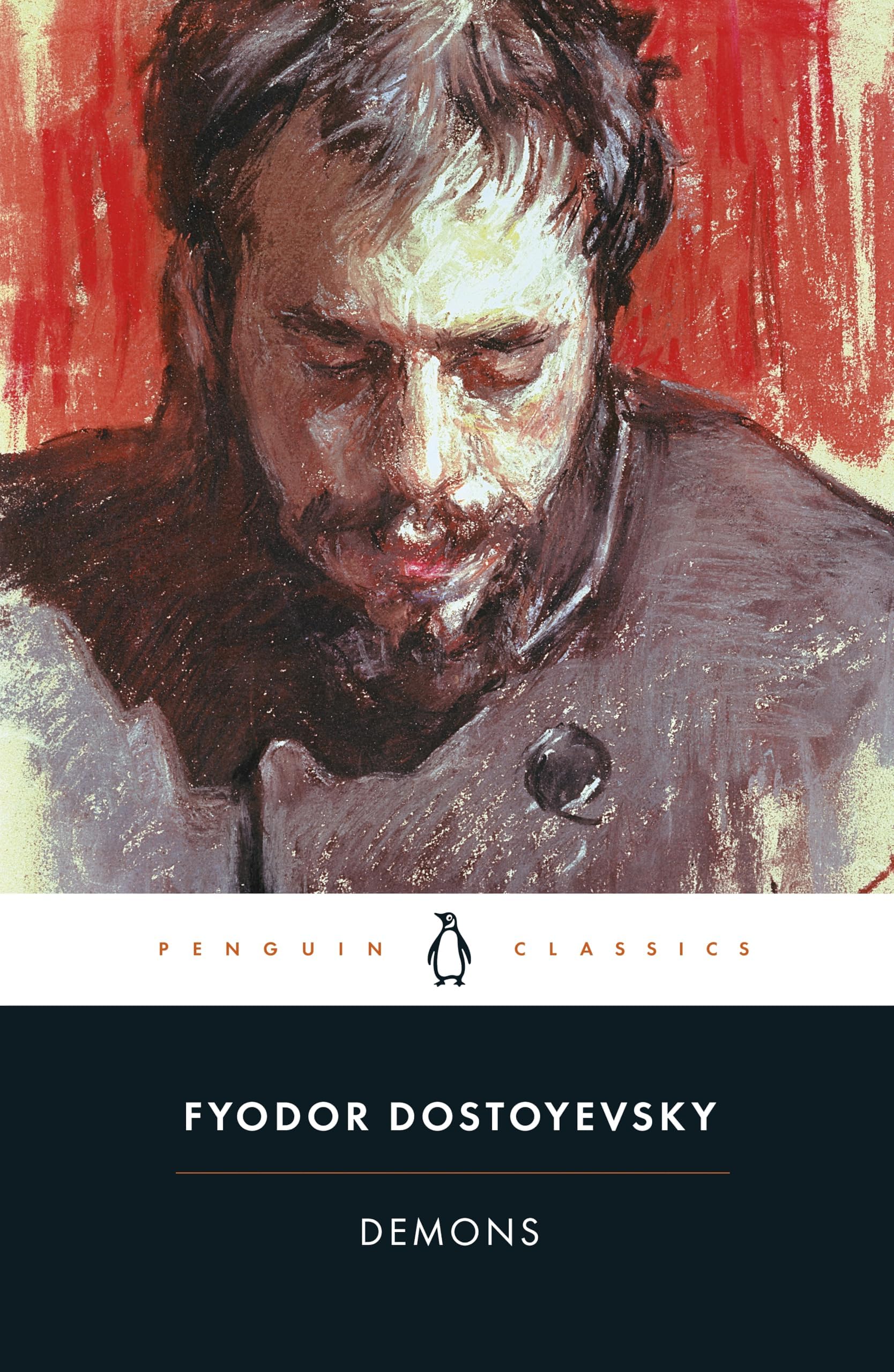
Demons
Product ID: 77880472
Desertcart purchases this item on your behalf and handles shipping, customs, and support to UAE.
Demons , also known as The Possessed or The Devils , is a dark masterpiece that evokes a world where the lines between and good and evil long ago became blurred. This Penguin Classics edition of Fyodor Dostoyevsky's Demons is translated by Robert A. Maguire and edited by Ronald Meyer, with an introduction by Robert L. Belknap. Pyotr Verkhovensky and Nikolai Stavrogin are the leaders of a Russian revolutionary cell. Their aim is to overthrow the Tsar, destroy society and seize power for themselves. Together they train terrorists who are willing to go to any lengths to achieve their goals - even if the mission means suicide. But when it seems their motley group is about to be discovered, will their recruits be willing to kill one of their own circle in order to cover their tracks? As the ensuing investigation and trial reveal the true identity of the murderer, Dostoyevsky's and everyone's faith in humanity is tested. Partly based on the real-life case of a student murdered by his fellow revolutionaries, Dostoyevsky's sprawling novel is a powerful and prophetic, yet lively and often comic depiction of nineteenth-century Russia, and a savage indictment of the madness and nihilism of those who use violence to serve their beliefs. Robert A. Maguire's superb translation captures Dostoyevsky's vigorous prose. In his introduction, Robert L. Belknap discusses Dostoyevsky's own revolutionary activities, his narrative technique and use of different genres, and the background of Radicalism in Imperial Russia. Edited by Ronald Meyer, this volume also includes a chronology, further reading, notes and a glossary. Fyodor Mikhailovich Dostoyevsky (1821-1881) was born in Moscow. From 1849-54 he lived in a convict prison, and in later years his passion for gambling led him deeply into debt. His other works available in Penguin Classics include Crime & Punishment , The Idiot and Demons . If you enjoyed Demons , you might like Joris-Karl Huysmans' The Damned (Là-Bas) , also available in Penguin Classics. Review: Demons - I love this book frfr, my fav outta Dostoevsky. Review: Quality and content - Book recived in little damaged condition, but never mind! Demons, A blunt masterpiece that ever delivered by FD. I have all Major collection of dostoyevsky's works and all are fabulous! Go for it.












| Best Sellers Rank | #5,159 in Books ( See Top 100 in Books ) #238 in Classic Fiction (Books) |
| Customer Reviews | 4.5 out of 5 stars 1,035 Reviews |
U**O
Demons
I love this book frfr, my fav outta Dostoevsky.
S**T
Quality and content
Book recived in little damaged condition, but never mind! Demons, A blunt masterpiece that ever delivered by FD. I have all Major collection of dostoyevsky's works and all are fabulous! Go for it.
S**I
The quality is good
Nice book the quality is good
R**S
Just stop sticking stickers on the book, it's not even a barcode sticker.
The reason I gave 4 stars despite the book quality being exceptionally well is because of sticking stickers on the book, which I don't like, and while removing it the paperback colour comes along with it, just go for it with eyes closed. Print is really well to read, you won't find it hard for your eyes, and also I've got the book with minute damages only on the outside but I didn't return it because the overall quality is very good.
A**R
good book
good book
V**H
Fyodor dostoevsky special
I am in love this book and cover
0**R
The book was received in excellent condition.
The print and paper quality are acceptable for the price point. The main pro is that the font is readable, there is no missing text.
S**A
Good purchase
Good purchase
L**A
Must read
Loved it! Must read. Very interesting plot twist.
E**O
Ok
Grande casa editrice. Pagine perfette, , caratteri chiari. Non vedo l’ora di farei altri acquisti di libri, sicuro che saranno i migliori.
E**S
Excelente portada
Excelente edición. Nota importante, es en inglés, pero está maravillosa
D**T
Lovely translation, complex book
The book itself is not for everyone. If you have read some Dostoyevsky before, it’s more accessible, but it’s still 700 pages plus an extra 200 for annotations and explanations. I’m not a professor for literature tho, so maybe ask someone who actually has a more trustworthy opinion. The edition is beautifully compiled. The book contains a few chapters that help ease you into Dostoyevsky’s style, a short biography of his life and works, and a quick introduction to the book. The translation itself is magnificent. The footnotes are moved to the end so the pages are uninterrupted and there’s a list of the character names including relation and nicknames. And there’s about 150 pages of details and explanations as to why Dostoyevsky chose this specific phrasing, or what this sentence might refer to, or why this made sense back when the book was written. Whoever made this was not only incredible educated and thorough, but also clearly loved Dostoyevsky’s works and it really shows. If you want to read the book in English, I definitely recommend this translation. The only thing I will warn about, is that Dostoyevsky likes to regularly weave in French in dialogues, which the translator chose to keep. All French is of course translated in the footnotes, but in some of the dialogue-heavy scenes this can mean having to jump back and forth between text and appendix quite a lot. If you know French or are willing to put in the effort, this shouldn’t cause too much trouble though. TLDR; the book itself is not for everyone, but this translation is wonderful.
F**A
An exemplary translation
Demons or Devils or The Possessed, depending on which translation you pick up, is a complex book. Dostoyevsky himself admitted in a letter that he would sacrifice straightforward readability for the tendentiousness of the message(s) he transmits in this novel. As an example the narrator Gogonov shifts from being part of the narrative and observing events to being completely detached from the tale being told. At times the reader wonders how he knows so much of what he tells. He goes from describing the plot without judgment, to judging very acutely certain occurrences and characters being described. Demons takes on a smörgåsbord of very dense political, philosophical and religious issues. This is one of the high points of the novel, its 'inner stuffing,' standard Dostoyevsky fare. You may be forced to stop at times and re-read passages or discussions amongst the characters, to try to take them in, chew them and consider them seriously. Dostoyevsky intended for his audience to ponder the case in point. Many have hailed him prophetic in his prediction - through Shigalyov's political utopia - of the amount of people that would be slaughtered in the 20th century due to political ideologies that did for the most part tend to tilt to the side of 'ego trips', as Robert Belknap correctly observes in the introduction - Stalin, Hitler, Mao, and so on - the number being around 100 million. Most importantly, Dostoyevsky was worried about the influence of materialist, nihilistic and atheistic ideas, aggressively transmitted, which could 'infect' or spread through the inadvertent youth of the day - and did eventually lead to the disasters Russia underwent following its 1917 revolution - when he wrote Demons. Of no less importance is the religious side, with Kirillov and the monk Tikhon as the main proponents, as well as the holy fool Semyon Yakovlevich. There is much that is discussed regarding God, Christ, the church, etc. providing food for philosophical as well as religious thought. The story is divided into three parts, the first concerning itself chiefly with high society in a rural town in 1860's Russia - the 'Society Tale' -, followed by a second part - the Anti-Nihilist 'political tract', if you will - which details closely the workings of the main characters of the work as they plant the seeds of the havoc that will ensue in the third part of the novel, Belknap considering it to be the 'Psychological Novel' part, the invention of which is accredited to Dostoyevsky himself. Demons is profoundly moving. It is inevitable that you sympathize with the main 'villain' - clearly a troubled character - Stavrogin. This man, and his continuous bouts of clear consciousness and what one sees as kindness and magnanimity, make the analysis of his behavior on the other side of the spectrum harder. It is an unfortunate debacle, the state of affairs he ends up creating for himself. Dostoyevsky was clearly pointing the finger at the 'softer' radicals of the 1840's as being the root of the calamity. Their jabberings in support of what were considered 'new' ideas, all the nihilistic and atheistic propositions that were en vogue at the time, would lead to a more active radical next generation that would take it upon itself to 'shake the very foundations of society' and it's moral mores. In the end I gave the book 5 stars because this version is absolutely fantastic. The endnotes are comprehensive and give a much-needed overall guide to Russian cultural and other references throughout the work, as well as a splendid introduction which I read after completing the novel, a chronology, a dictionary of the terms and a list of the characters. A very fine edition from Penguin. If you want to read Dostoyevsky, maybe you could treat yourself to start with The Idiot or something softer, more accessible. But if you want to rush straight into one of his more problematic and intense works, look no further. Just the character Kirillov makes such a dramatic appearance. He is at once a rational, delusional, sympathetic and extreme person, who will keep you hooked to his speeches and actions. Highly recommended.
Trustpilot
1 month ago
2 weeks ago