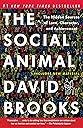
The Social Animal
Product ID: 78249163
Desertcart purchases this item on your behalf and handles shipping, customs, and support to UAE.
#1 NEW YORK TIMES BESTSELLERWith unequaled insight and brio, New York Times columnist David Brooks has long explored and explained the way we live. Now Brooks turns to the building blocks of human flourishing in a multilayered, profoundly illuminating work grounded in everyday life. This is the story of how success happens, told through the lives of one composite American couple, Harold and Erica. Drawing on a wealth of current research from numerous disciplines, Brooks takes Harold and Erica from infancy to old age, illustrating a fundamental new understanding of human nature along the way: The unconscious mind, it turns out, is not a dark, vestigial place, but a creative one, where most of the brain’s work gets done. This is the realm where character is formed and where our most important life decisions are made—the natural habitat of The Social Animal. Brooks reveals the deeply social aspect of our minds and exposes the bias in modern culture that overemphasizes rationalism, individualism, and IQ. He demolishes conventional definitions of success and looks toward a culture based on trust and humility. The Social Animal is a moving intellectual adventure, a story of achievement and a defense of progress. It is an essential book for our time—one that will have broad social impact and will change the way we see ourselves and the world. Review: Excellent book - A very well written and insightful book. Well researched by the author. Review: Thought provoking. Beautifully written. - It will teach you a lot about how a modern, evolved human beings are still similar in many ways to chimps found in jungles. How after a million years of evolution our animal part of brain is still running the show. How our instincts and reactions have all the control.
| Best Sellers Rank | #23,850 in Books ( See Top 100 in Books ) #993 in Analysis & Strategy #1,330 in Reference (Books) #1,766 in Self-Help |
| Customer Reviews | 4.4 out of 5 stars 1,182 Reviews |
B**U
Excellent book
A very well written and insightful book. Well researched by the author.
V**R
Thought provoking. Beautifully written.
It will teach you a lot about how a modern, evolved human beings are still similar in many ways to chimps found in jungles. How after a million years of evolution our animal part of brain is still running the show. How our instincts and reactions have all the control.
H**N
Good print and paper quality. Authentic product
Good quality book. Good print
A**O
Poor quality pages
Poor quality pages. Specially for price of 750.
B**R
Quality of pages and cover is not very good
The paper quality of the book is not very good, be it external cover or the internal pages. The print is also blurry on some pages which makes it difficult to read. Though the content is amazing.
S**A
Doesnt look original copy
Doesn't look like its the original copy, looks a duplicated published book..
A**R
Bad paper n print quality
Bad paper quality n print.. not worth spending Rs 1000
S**R
Very good
This book is so very good. I was looking for inspiration to pick me up and return me to my cheerful go getter mode, and this book made me feel good and focused. I read books to clear my mind and gain perspective. This book provided that in abundance.
A**Y
Great read, good humor!
Great read, story and psychologically interesting and entertaining. I haven't even finished but have already given it as a gift.
M**R
Brilliant, Educational, and quite deep!
I bought this after hearing that policy makers were clambering as it gave such insight into "the human condition", so I was expecting a popular science type book along the lines of Freakonomics, Tipping Point etc. This book was so much more, the narrative of Harold and Erica gave real substance to the facts provided and the arguments made. Every page is crammed full of fascinating facts from the number of physical contacts Brits make compared to South Americans while having coffee to how the brain works. It's also a kind of a manifesto for the sub-conscious, if we are the sum of our experiences then you could look at the sub-conscious as our soul - deep stuff.... I really enjoyed the book and have made a page of facts to use in presentations and another page of books to read from the bibliography! Well worth buying
S**E
Best Book I've Read
Devoured this book in just a few days. An interesting look at life. Could not put it down and immediatly ordered more David Brooks books after finishing this one. A fabulous read for a student of sociology or of life, for that matter.
N**A
surprisingly entertaining and informative
I must be the ideal audience for this book because I found it to be a wonderful mix of great writing, new ideas, and interesting information. The goals of Brooks' book are "to synthesize [recent scientific] findings into one narrative... to describe how this research influences the way we understand human nature... to draw out the social, political, and moral implications of these findings." He achieves the goal of aggregating the research admirably. I don't consider myself well read on brain and cognitive sciences but I read several science blogs and had encountered many of the info-bites he introduces, many of which are extremely recent. A random sampling of research results he mentions: "six-month-old babies can spot the different facial features of different monkeyse, even though, to adults, [the monkeys] all look the same." "Anthropologists tell us that all cultures distinguish colors. When they do, all cultures begin with words for white and black. If the culture adds a word for a third color, it is always red." Brookes uses a device of narrating the lives of 2 invented people, Erica and Harold. For example, to illustrate ideas on decision making, he introduces Erica's coworker Raymond whose "knowledge of his own shortcomings was encyclopedic. He knew he had trouble comparing more than two options at a time... so he would build brackets and move from one binary comparison to the next. He knew he liked hearing evidence that confirmed his opinions, so he asked Erica and others to give him the counterevidence first," etc. After describing a situation within the context of the narrative, Brooks jumps in to elaborate with more information. I feared this tactic would be too forced and would thereby fall on its face but he actually pulls it off! He binds up all the ideas in a cohesive story that has surprisingly sympathetic characters and a completely unexpectedly interesting character-driven plot. Brooks uses his characters' lives and personalities to illustrate his ideas. One theme that arises is that rational thought is far from the dominant component of human reality: "Unaware of what is going on deep down inside, the conscious mind assigns itself the starring role... people are still blind to the way unconscious affections and aversions shape daily life." Underestimating the importance of culture in forming the subconscious and thus human behaviors causes the government to misdirect their energies, focusing on "money and guns" rather than community. Brooks argues for a more paternalistic government that shapes culture: "You can pump money into poor areas, but without cultures that foster self-control, you won't get social mobility... You can establish elections but without responsible citizens, democracy won't flourish... it was not enough to secure a village; they had to hold it so that people could feel safe, they had to build schools, medical facilites, courts, and irrigation ditches; they had to reconvene town councils... the hardest political activity- warfare- depended on the softest social skills- listening, understanding, and building trust." Brooks' characteristic writing style is funny, engaging, and smart, but sometimes sarcastic and intentionally provokative/offensive. Example: "Like most upper- amd upper-middle-class children, these kids are really good at obscure sports. Centuries ago, members of the educated class discovered that they could no longer compete in football, baseball, and basketball, so they stole lacrosse from the American Indians to give them something to dominate." I'd seen this style of soft science writing before, most recently in a book called Spent: Sex, Evolution, and Consumer Behavior . Brooks manages to keep his punchiness sparse enough that I don't tire of it but if that style doesn't appeal to you, you may want to steer clear. At times Brooks writes beautifully, surprising me with his poetic phrasing, so for me this book also holds artistic value. In writing about the human mind, he explores happiness and the meaning of life, pulling from sources ranging from Walt Whitman to Poincare. Describing Harold's impending death, he writes, "his wife and his nurses served him with a care, patience, and devotion that surpassed all expectation. Their efforts were more dear to him because he knew that he could never repay them... It was hard at first to simply fall backward into their love." This book is great for someone who's interested in the human mind and wants an incomplete overview of recent developments in that area. It's also great for people who are interested in a unique perspective on how human nature relates to society and politics. Keep in mind Brooks is not a scientist- he's a journalist interested in culture and he uses various studies to inform his view but does not analyze the science. This book does not offer deep analysis of studies, nor does it come close to being exhaustive in its depiction of all the research done in this field.
Trustpilot
1 month ago
2 weeks ago